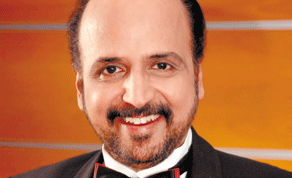
The International Monetary Fund (IMF) could “comfortably” commit to lending about $390bn without putting its balance sheet at risk, according to Doha Bank Group CEO R Seetharaman (pictured).

However, in a worst-case scenario, the Breton Wood’s institution might need to lend about $840bn, he said in his presentation at the IMF-World Bank meeting held in Washington.
Emerging economies have called for the IMF to develop a short-term liquidity facility, similar to a currency swap line, which countries could draw on quickly in case global credit markets seize up, he said.
Highlighting that the IMF projections show that in a “severe scenario”, the capital adequacy ratios of emerging markets banks could be reduced by as much as six percentage points, he said “this scenario is not the most likely but is possible.”
Banks in both advanced and emerging economies need to strengthen capital buffers against potentially major economic shocks, he said.
Finding that the IMF assumes a possible sharp drop in emerging economy growth rates over the next couple of years, a rise in funding costs and a significant fall in emerging economies’ terms of trade, Seetharaman said, “this would raise non-performing loan levels and erode capital ratios of emerging market banks.”
More generally, sovereign credit strains have severely weakened banks, especially in the eurozone, and only a commitment by governments to mid-term fiscal consolidation coupled with bank re-capitalisation can avoid a worsening crisis of confidence, according to him.
Seetharaman said emerging-market and developing nations should rebuild “policy buffers”, contain overheating in their economies and be ready to face volatile capital flows. The worsening European debt crisis and threat of a US recession have erased about $12trn from global equities since the beginning of May 2011, he added.
The epicentre of the current crisis remains Greece and Europe must carry through with its July 21 commitments to set up a €440bn ($610bn) fund to backstop banks jeopardised by a Greek default, he said. However, emerging market and developing countries are responsible for the larger share of world economy growth and have a bigger role to play, Seetharaman said, adding “a revival of global demand will depend to a large extent on these countries.”