


Reuters/Zurich
 |
|
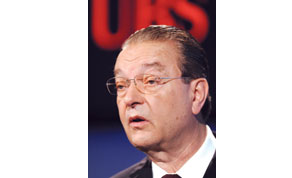
Gruebel: ‘I did not take the step of resigning lightly.’ |
The bank, which said it would beef up risk controls under an accelerated restructuring of that part of its business, named its Europe, Middle East and Africa head Sergio Ermotti to replace Gruebel on an interim basis.
Gruebel, appointed in 2009 to rebuild UBS after a near collapse, said in a message to staff: “That it was possible for one of our traders in London to inflict a multi-billion loss on our bank through unauthorised trading shocked me, as it did everyone else, deeply.”
The incident had global repercussions, including political ones. “I did not take the step of resigning lightly. I am convinced that it is in the best interests of UBS to approach the future with a new leader at the top,” he said.
Gruebel, a 67-year-old former trader who helped turn around Credit Suisse a decade ago, was brought out of retirement to try to revamp UBS after it almost collapsed in 2008 under the weight of more than $50bn lost on toxic assets.
UBS chairman Kaspar Villiger said the board of directors, who met in Singapore this week, had not lost confidence in Gruebel despite the scandal and had tried to convince him to stay on to allow a more orderly succession next year.
Ermotti, who Villiger said was a strong candidate to replace Gruebel permanently, said the bank would review its risk controls at group level, and an internal investigation of what went wrong at the investment bank should conclude in 10 to 14 days.
More details of changes at the division, which would scale back but not exit its fixed income business, would be revealed at an investor day already planned for November 17 in New York, Ermotti said.
A 51 year-old from Switzerland’s Italian-speaking region of Ticino, he was already being groomed as a possible successor since he joined UBS in April from UniCredit after he was passed over in a management reshuffle at the Italian bank following the departure of CEO Alessandro Profumo.
Villiger said he had no doubts about the future of investment bank head Carsten Kengeter, whose fate had also hung in the balance, saying he and his team had done an “excellent job” to limit losses from the unauthorised trades by quickly closing the positions.
Villiger declined to comment on whether Kengeter could still be a candidate to take over as CEO, saying only the board was looking at both internal and external candidates and should decide on a permanent replacement within six months.
Villiger, a former Swiss finance minister who also faced calls to resign over the scandal, said the bank was sticking to plans for former Bundesbank chief Axel Weber to join the board next year and take over as chairman in 2013, adding Weber would be involved in the choice of a new CEO.
He said he did not favour splitting off investment banking from the rest of the bank, but said the board wanted Ermotti to speed up an overhaul of the division to better align it with UBS’s core business of managing wealthy clients’ money.
“We want to turn this disaster into an opportunity,” he said.
Ermotti said there could be more job cuts in the investment bank but did not expect them to be extensive.
UBS had already said in August it would axe 3,500 more jobs to shave 2bn Swiss francs off annual costs, with almost half from the investment bank, which had grown to almost 18,000 staff from 16,500 a year ago.
The alleged rogue trader, Kweku Adoboli, was “sorry beyond words for what had happened” and was “appalled at the scale of the consequences of his disastrous miscalculations”, his lawyer Patrick Gibb said at a court hearing in London on Thursday.
The 31-year old did not enter a plea and was remanded in custody until a further hearing next month.
Clients pulled nearly 400bn Swiss francs ($442bn) – almost a fifth of client assets – from UBS after the bank was battered in the financial crisis as by a prolonged dispute with the US tax authorities, and posted the biggest annual corporate loss in Swiss history.
Villiger said Gruebel had achieved an “impressive turnaround and strengthened UBS fundamentally”. But other private banks are now circling again to nab clients worried about reputational risk in the wake of the rogue trader affair.
Gruebel, who had already foregone his bonus for the last two years, would get no severance package as he had resigned.