


 |
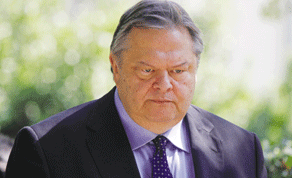
| Venizelos: All other discussions, rumours, comments, scenarios ... do not help our common European task |
Greek Finance Minister Evangelos Venizelos was quoted by two newspapers as saying an orderly default with a 50% haircut for bondholders was one of three possible scenarios for resolving the heavily indebted eurozone nation’s fiscal crunch.
Officials played down the reports and Venizelos described them in a statement as an unhelpful distraction from the central task of sticking to Greece’s EU/IMF bailout programme.
European Central Bank governing council member Klaas Knot told a Dutch daily a Greek default could no longer be ruled out, the first ECB policymaker to speak openly of the prospect.
“It is one of the scenarios,” Dutch daily Het Financieele Dagblad quoted him as saying. “All efforts are aimed at preventing this, but I am now less certain in excluding a bankruptcy than I was a few months ago.”
More signs emerged yesterday that European governments are working on re-capitalising vulnerable banks – perhaps in preparation for a Greek default – with France’s top market regulator saying 15 to 20 banks needed extra capital, although no French ones “at this stage”.
ECB policymakers said banks could be primed with long-term one-year liquidity to help shore them up.
Germany’s Jens Weidmann noted that the ECB had shown a willingness to do so in the past and his colleague Ewald Nowotny was more explicit.
“During the time of the financial crisis, one of the instruments we had was ... one-year tenders. I think it might be advisable to think about re-introducing this approach,” he said.
The International Monetary Fund reckons Europe’s banks need more fundamental re-capitalisation to the tune of €200bn and many bank analysts are gloomier than the Fund.
The European Commission said European banks had already received €420bn in funds since 2008 and were in much better shape than three years ago.
“The re-capitalisation of European banks is something that is ongoing, it is something that is already happening,” Commission spokesman Olivier Bailly told a regular briefing.
European shares fell again, leaving them on course for a fifth straight month of losses, after a commitment from G20 finance ministers and central bankers to “take all necessary actions to preserve the stability of the banking system and financial markets as required” failed to placate investors.
A statement issued after G20 talks in Washington on Thursday night said the 17-nation eurozone would implement “actions to increase the flexibility of the EFSF and to maximise its impact” by mid-October.
But it left unclear whether they would go beyond an already agreed widening of the eurozone bailout fund’s powers, which has so far failed to reassure markets.
Newspaper Ta Nea said Venizelos had told Socialist lawmakers behind closed doors that the government’s central scenario was to stick to austerity plans to receive a second €109bn ($146bn) bailout and avoid bankruptcy.
The alternatives were either an agreed restructuring of Greek debt with a 50% reduction in the face value of government bonds, or a disorderly default, he said.
Greek bank shares fell by 8% on the reports, prompting Venizelos to say: “All other discussions, rumours, comments, scenarios which are diverting our attention from this central target and Greece’s political obligation ... do not help our common European task.”
Deutsche Bank said European banks may face a bigger-than-expected hit from an internationally agreed swap arrangement on Greek government debt, which has still to be sealed.
Private sector creditors agreed in July to take a 21% loss on Greek bonds maturing before 2020, but the loss is more likely to be 25% or more, said Charlotte Jones, in charge of group controlling at Germany’s biggest lender.
The European Union’s top economic official, Olli Rehn, said in Washington that the EU was doing everything to avoid an uncontrolled default. He did not explicitly rule out an orderly restructuring of Greek debt, which many economists see as inevitable.
Venizelos will attend weekend meetings of the International Monetary Fund and World Bank in Washington and is expected to discuss Greece’s position with fellow ministers on the sidelines.
The government approved a raft of more draconian austerity measures this week, including putting 30,000 public employees on a path to redundancy, cutting pensions and raising taxes, in an effort to secure the next €8bn loan instalment vital to avoid running out of money in mid-October.
Shares of several European banks have plunged and funding costs have risen on worries about their exposure to debt issued by Greece and other debt-heavy European countries.
G20 participants did not say how the €440bn EFSF might be altered although French Finance Minister Francois Baroin used the word “leverage” in comments to reporters.
The US has previously proposed that Europe could leverage up the European Financial Stability Facility, giving it more firepower to protect the eurozone and its banks. German politicians and central bankers say that would be illegal.
Politicians in northern Europe, especially in Germany, have opposed dedicating more money to offset what they see as the profligacy of countries such as Greece. Those tensions have also flared within the European Central Bank over its role in buying bonds of struggling eurozone states.
However, Europe has come under heavy pressure from the US and other countries to take bolder steps.
On Thursday, US Treasury Secretary Timothy Geithner voiced optimism that Europe would devote more of its own resources to backstop euro area governments and banks.
Costly hole looms
Europe’s banks face a capital shortfall of hundreds of billions of euros if Greece forces them to slash the value of its debt by 50%, and other troubled eurozone countries like Italy and Ireland follow suit.
Banks could probably cope with a Greek default – analysts at Nomura put the total damage at €40bn ($54bn) – but markets would then focus on bigger countries and debt writedowns right across the region.
The country’s government later said it was still focusing on getting its second bailout done, but worries about Europe’s banks were left firmly in place after a statement from a French regulator said 15 to 20 banks needed more capital.
The same statement ruled out any French banks needing more capital however, and other major countries such as Germany and Spain are also dragging their heels, claiming their banks are in no desperate need – often at odds with the wider market view.
The IMF reckons Europe’s banks could need to re-capitalise to the tune of €400bn. Credit Suisse also calculates banks may need €400bn of capital by 2012 to fill a hole left by a recession, losses on sovereign debt and higher funding costs.
But Barclays Capital estimated European banks could need about €230bn to preserve their capital buffers in the extreme case they lose half the value of Greece, Irish, Italian, Portuguese and Spanish (GIIPS) debt.