


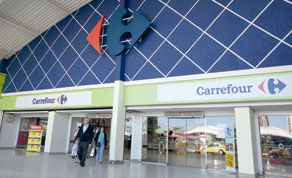
 Carrefour, Europe’s No1 retailer, warned 2011 profits would slump 15% as it cuts prices in a bid to reverse falling market share and tackle an increasingly tough economic environment.
Carrefour said it was downsizing its core Planet hypermarket revamp as it continued to face headwinds in Southern Europe, notably in Greece and Italy, and added that high commodity prices put at risk its purchasing gains goals.
“We are biting the bullet in 2011 and rebuilding momentum in 2012 to deliver long-term sustainable profitable growth,” chief executive Lars Olofsson said.
A string of European consumer-related companies including Ahold and Heineken have missed earnings forecasts recently as shoppers have cut spending amid rising prices and austerity measures.
Carrefour, the world’s No2 retailer behind US group Wal-Mart, has conceded it has also made mistakes, such as raising prices in its main French market above rivals such as E Leclerc and Intermarche.
The group, with more than 9,500 stores in 32 countries, reported a well-flagged 22% drop in first-half current operating profit to 772mn euros.
Carrefour said a goal to achieve cumulated cost savings of €1.9bn by 2012 under the three-year plan was intact, having achieved €236mn in the first half alone.
Carrefour’s shares have plunged 40% this year, hitting a more than 10-year low of €16.675 this month.
First-half underlying operating profits dropped 40% in France, where Carrefour makes over 40% of its sales, and were down 33% elsewhere in Europe. They were up 27% in Latin America and 11% in Asia.
Aer Lingus
Irish airline Aer Lingus said strong bookings for the second half of 2011 meant it would recover from a first-half loss to post a full-year operating profit.
The airline posted an operating loss of €27.8mn ($40mn) for the first six months as higher average fares per passenger failed to make up for lower passenger numbers and a €5mn loss from an industrial dispute.
But it said it would post a full-year operating profit in the region of €1mn to €22mn, in part by focusing capacity on bringing passengers to Ireland from faster-growing parts of Europe, like Germany, Belgium and the Netherlands.
The airline increased its average yield, or fare, per passenger in the first six months by 8.4% on a year ago by focusing its capacity on higher-margin routes.
Revenue was up 5.8% in the first half from a year ago and Mueller said he expected that rate to continue in the second half.
Cost savings under the company’s Greenfield programme would reach €80mn by the end of the year, Macfarlane said.
Bouygues
French conglomerate Bouygues moved to address the sharp fall in its share price yesterday with a planned €1.25bn ($1.81bn) share buyback programme, sending the stock higher.
The telecoms, media and construction group also tweaked its sales target for the year higher after a 4% increase in first-half sales as its construction unit returned to growth.
Bouygues shares have fallen around 26% in the last three months on concerns about the impact of the global economic slowdown on its construction unit and increasing competition in the mobile telecoms market.
As a result, the company’s market capitalisation has shrunk to around €8.4bn, below the group’s shareholders equity of €9bn at the end of June. Bouygues’ larger rival Vinci and Vivendi, the telecom and entertainment group, said yesterday that they are not planning share buybacks.
The company also slightly upgraded its sales target for 2011 to €32bn from €31.9bn as it reported a 27% fall in first-half net profit to €391mn from €532mn a year earlier.
The decline in net profit, which beat an average of €348mn in a Reuters poll of four analysts, reflected a lower contribution from Bouygues’ 31% stake in power and transport engineering company Alstom.
The group reported a 4% increase in first-half sales to €15.2bn as the construction business returned to growth.
Vivendi
Telecoms and entertainment group Vivendi confirmed annual goals and posted first-half profits up in line with expectations as growth in video games and Brazilian telecoms offset weakness in its key French mobile business.
The results showed how France’s Vivendi has been recast after buying out Vodafone’s 44% stake in SFR to take full ownership of France’s second-biggest telecom operator.
It now has wider exposure to France as competition heats up ahead of the entry of new mobile operator Iliad and a heavy debt load, but Vivendi also has a cleaner financial structure and better cash flow.
“We now have full control of all our assets and have simplified our organisation,” chief executive Jean-Bernard Levy said in a statement. “Vivendi has achieved an essential strategic objective on very favourable financial terms.”
First-half earnings before interest, tax and amortisation (EBITA) rose 3.7% to €3.36bn ($4.87bn), while revenue was up 1.9% to €14.25bn. Adjusted net income rose 20.2% to €1.83bn, boosted by favourable, one-off tax credits linked to Vivendi’s minority buyout of SFR.
Analysts polled by Reuters had on average expected EBITA of €3.31bn, revenue of €14.24bn and adjusted net profit of €1.73bn.
The first-half results continued to show the diverging prospects for Vivendi’s various businesses with growth coming from Activision Blizzard’s video games and Brazilian fixed telecom operator GVT.
Bertelsmann
The German media group Bertelsmann, which owns the broadcaster RTL, said yesterday that it had made a net profit of €269mn ($388mn) in the first half of the year.
That represented a gain of 9.3% from the same period in 2010, and was helped by lower interest payments on Bertelsmann’s reduced debt load of €2bn at the end of June, a statement said.
Bertelsmann sales were 1.9% higher on the year at €7.2bn, it added, with strong contributions from advertising by the RTL Group and publishing company Gruner Jahr.
The parent company’s operating profit slipped however by 2.0% to €737mn.
For the full year, Bertelsmann still expects a moderate increase in sales and a net profit that surpasses the 2010 level of €478mn.
Operating profit is forecast to decline however owing to the costs of new products and higher energy prices.
Lukoil
Lukoil, Russia’s second-biggest oil producer, reported a 67% rise in second-quarter net profit to $3.25bn, beating analysts’ forecast of $2.9bn, as declining crude output was offset by rising prices.
Lukoil is suffering from oil production decline due to depleted West Siberian reserves and looking elsewhere, including Africa and Asia, to boost its upstream business.
The company said its April-June crude oil output fell 5.6% to 22.74mn tonnes, but rising crude prices had improved refining margins.
Vagit Alekperov, Lukoil’s long-standing chief executive, told Reuters that crude production is set to decline by up to 4% for the whole 2011 year, while next year it will see flat output.
“There will be a stabilisation of production in 2012, and growth will start by 2013,” Alekperov told Reuters in an interview.
Lukoil said its second-quarter sales rose to $34.9bn from $25.85bn in the year-earlier period, while analysts expected revenues to rise to $34.28bn.
Earnings before interest, taxes, depreciation and amortisation (EBITDA) increased to $5.35bn from $3.7bn in the second quarter of 2010, beating an average forecast of $4.77bn in a Reuters poll.