


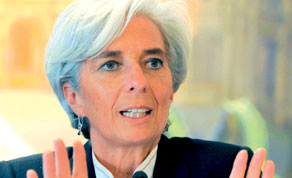

Lagarde: ‘... we must act now
Reuters/Jackson Hole, Wyoming
The new head of the IMF warned yesterday that the global economy risks falling back into recession and called for urgent co-ordinated policy action, including the mandatory re-capitalisation of European banks.
“Developments this summer have indicated we are in a dangerous new phase,” International Monetary Fund Managing Director Christine Lagarde said at an annual gathering of global policymakers hosted by the Kansas City Federal Reserve Bank.
“The stakes are clear; we risk seeing the fragile recovery derailed. So we must act now,” she added.
Two years after the end of the worst of the recent financial crisis, growth in both the US and Europe is sputtering, and debt crises on both sides of the Atlantic have shaken public confidence in a global recovery.
Advanced economies must forge long-term plans to bring their debt under control, but at the same time should not pursue belt-tightening so fast that it imperils recovery, Lagarde said yesterday.
“Put simply, macroeconomic policies must support growth,” the former French economy minister said in her first major policy speech since taking over the top IMF job from Dominique Strauss-Kahn in July.
“Monetary policy also should remain highly accommodative, as the risk of recession outweighs the risk of inflation,” she said, adding that central bank should stand ready to jump back into unconventional policy actions if needed.
European banks need to be re-capitalised, she said, adding that the most efficient way to do so would be “mandatory substantial re-capitalisation” through private channels if possible, but otherwise some form of public Europe-wide funding. Individual European countries must also put in place deficit-cutting plans with a “credible finance path” – including, she said, continued support from the European Central Bank.
In the US, the focus on long-term fiscal consolidation must not ignore the importance of fostering near-term growth, she said.
“After all who will believe that commitments to cut spending can survive a lengthy stagnation with prolonged high unemployment and social dissatisfaction?” she asked.
Policymakers must also stop the slide in the US housing market, she said, relying on intervention by government housing finance agencies and more aggressive programmes to reduce homeowner debt.
IMF first deputy managing director John Lipsky meanwhile said the IMF’s updated forecasts to be released next month do not foresee a global recession but risks have risen. “I can say that our base case is certainly not a recession.
“There’s no doubt however that risks have risen given the weak performance in many economic data in the last few months,” he added.
Lipsky said rising risks to the global economy reflected a lack of confidence in policymakers’ ability to rein in debts.
He urged both the US and Europe to develop credible medium-term fiscal plans to boost confidence in their ability to cut their debt levels.
“It is clear what is needed is credible medium-term fiscal plans that will give confidence to investors and others that the deficit will be controlled and fiscal policy will be appropriate in the medium term,” Lipsky said, speaking from the US Federal Reserve’s annual retreat in Jackson Hole, Wyoming.
“The more credible medium term planning, the more flexibility that will exist with temporary impacts, such as potential impact of the hurricane (Irene),” said Lipsky.
He said effective fiscal measures could include a combination of US tax reforms and clear-cut spending plans.
The White House said President Barack Obama and IMF chief Christine Lagarde spoke by phone on Friday and agreed that the world economy needs further steps to boost growth in the short term.