Bloomberg/Dubai
Bond sales by issuers in the Arabian Gulf fell to a five-year low as debt crises in developed nations threaten a recovery in investor confidence after the Middle East’s worst political turmoil in at least four decades.

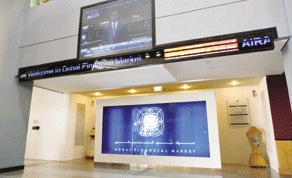
A television news chanel is displayed at the entrance to the Dubai Financial Market in Dubai. The cost of insuring Dubai’s bonds from default using five-year credit-default swaps jumped to the highest in four months on August 11, according to data provider CMA, after Standard & Poor’s cut the US debt rating from the highest grade of AAA
Offerings have slumped 23% this year to $11.8bn from a year earlier, data compiled by Bloomberg show. Dubai-based Majid Al Futtaim Group, Abu Dhabi-based Dolphin Energy Ltd and Tourism Development & Investment Co have put off sales since June. The extra yield borrowers from the Middle East must pay over US Treasuries surged 99 basis points this quarter to 431 on August 10, the most since October 2009, according to indexes compiled by JPMorgan Chase & Co.
“As long as global markets remain fragile, it will be difficult for regional names to sell bonds internationally,” Nick Stadtmiller, a fixed-income analyst at lender Emirates NBD, said in an e-mail on August 15. “Local bond issuers depend on international participation in a successful sale.”
Concern the US economy may be headed for recession has spurred a Federal Reserve vow to keep benchmark interest rates at almost zero through mid-2013. The European Central Bank resumed buying eurozone government bonds this month as lawmakers failed to convince investors they could contain the region’s debt crisis. Companies globally are paying the most to borrow relative to benchmark government debt since September 2009 as investors shun all but the safest securities.
The extra yield investors worldwide demand to own corporate rather than government debt is 214 basis points, up from this year’s low of 145 on April 11, according to Bank of America Merrill Lynch’s Global Broad Market Corporate Index.
In the Gulf, the gap between the region’s debt yields and the London interbank offered rate reached 310 basis points, or 3.1 percentage point, on August 11, the widest since June 2010, the HSBC/Nasdaq Dubai GCC Conventional US Dollar Bond Index shows. The difference fell to 290 on August 16.
The cost of insuring Dubai’s bonds from default using five-year credit-default swaps jumped to the highest in four months on August 11, according to data provider CMA, after Standard & Poor’s cut the US debt rating from the highest grade of AAA. The contracts pay the buyer face value in exchange for the underlying securities or the cash equivalent should and government or company fails to adhere to its debt agreements.
Protests in the Middle East, which have killed thousands in Libya, Syria and Yemen this year and toppled long-serving rulers in Tunisia and Egypt, raised the cost of borrowing for Arabian Gulf issuers to a 10-month high on March 18.
The difference between the yield on Gulf bonds and Libor, which jumped to 289 basis points on March 17, fell to 217 on May 19, the lowest since July 2008.
“There was a rather short window of opportunity to issue bonds this year,” Emirates NBD’s Stadtmiller said.
“Had the situation not evolved in terms of the Mideast crisis, we would have seen around five more issuers coming to the market at the beginning of this year,” Abrar Hussain, the Manama, Bahrain-based head of debt capital markets for the Middle East at Credit Agricole CIB said in a phone interview on August 15. Fourteen borrowers tapped the market so far this year, compared with 15 in the same period of 2010.
Now is an opportune time to sell debt, according to Tarek Elalaily, the London-based director of Middle Eastern and North African fixed-income sales at New York-based Cantor Fitzgerald.
Gulf states hold more than a third of the world’s proven crude oil reserves, according to data compiled by Bloomberg.
Regional issuers “should get involved and block out the noise,” Elalaily said by e-mail on August 15. “Gulf states’ public finances are in order, and they have a low debt burden, with Dubai the exception.”
Dubai borrowed about $113bn to become the region’s financial and tourism hub, according to June 16 report by the International Monetary Fund.
UAE’s First Gulf Bank received $3.8bn in bids for a $650mn five-year Islamic bond it sold in July, sales manager Standard Chartered said. Saudi International Petrochemical Co, known as Sipchem, raised 1.8bn riyals ($480mn) from the sale of sukuk, the company said on July 4. The offer received orders of about 4.5bn riyals.
The $11.8bn in Gulf bond sales so far in 2011 is the lowest since $11.5bn was issued in the same period of 2006, data compiled by Bloomberg show.
“I think it’s likely that issuers will come to market later this year,” Credit Agricole’s Hussain said. “We are working on a few deals, and we do expect sales to rise this year. If growth in the US and Europe is anemic, and you’re an investor looking for returns, you’d probably look in the emerging markets, and that includes the Gulf.”
Bonds in the region have returned 7.7% so far this year, according to the HSBC/Nasdaq Dubai index, while emerging market debt gained 6.6%, JPMorgan Chase & Co’s EMBI Global Composite Index shows.