Reuters/London
A rout in crude tanker earnings could extend into 2012 if global economic turmoil grows as the sector struggles with an oversupply of vessels, a senior executive with leading maritime transport group Teekay said.

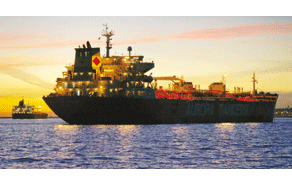
Oil tankers are anchored near the Port of Long Beach, California, US. A glut of vessels, ordered before the financial crisis in 2008, has hit the water this year with rates sliding to record lows in recent days as growing availability has continued to overwhelm the sector
A glut of vessels, ordered before the financial crisis in 2008, has hit the water this year with rates sliding to record lows in recent days as growing availability has continued to overwhelm the sector.
“The market is in an oversupply situation and being such a commoditised pricing market, rates are at some of the lowest levels we have seen in many years,” said Bruce Chan, chief executive of Teekay Tankers, a unit of Teekay. “In general we do not see not a lot of change for the rest of the year,” he told Reuters yesterday.
Chan said seasonal factors such as weather delays and increased winter demand for oil would provide scope for gains.
“But in terms of the historical context, we see rates being in the lower end for the rest of the year,” he said.
The possibility of slowing oil demand in the US and Europe would hit the crude tanker sector hard next year.
“Shipping is directly affected by the world economy and oil demand and so the fear is of a double dip recession and what happens would have a negative impact on shipping,” Chan said. “Oil demand next year is the big variable to whether we are in balance or whether it’s another year of continued weakness.”
“End-user oil demand leaves little room for optimism and rates could remain in current low territory,” Peter Sand, chief shipping analyst with ship association Bimco, said yesterday. “Moreover, the crude tanker segments will see strong inflow of new tonnage adding downside to the demand-supply balance.”
Average earnings for very large crude carriers (VLCCs), which can carry up to 2mn barrels of crude oil, have slid to as low as -$1,889 a day, meaning owners are paying the voyage costs for those hiring vessels. VLCC earnings are also below operating costs, estimated at around $10,000 a day.
Teekay Tankers operates a fleet of smaller aframax and suezmax tankers, which carry a maximum of 600,000 and 1mn barrels of crude oil respectively.
Aframaxes and suezmaxes are also not covering operating cost levels estimated at $7,600 a day and over $8,000 a day respectively. That compared with average earnings of $2,794 and $3,167 a day reached on Tuesday, Baltic Exchange data showed.
Teekay Tankers reported adjusted net income of $4.3mn, or 7¢ per share for the quarter ending June 30, 2011, down from $7.6mn or 18¢ per share in the same period last year.
Chan said it had covered 60% of its portfolio at fixed rate charters rather than in the spot market for the rest of the year and 55% at fixed rates for the next 12 months.
“There are a few including Teekay that have taken on enough fixed rate cover that we are still generating positive cash flow,” he said. “But for those that are predominantly spot, low rates are draining their bank accounts slowly and so the question is how much of a balance sheet strength and capability do they have heading into this low part of the market and it will be a direct correlation to how long they can survive these low rates.”
Chan said casualties and bankruptcies in the sector were “a definitely possibility”, adding that there would be more asset sales to generate cash flow and foreclosures by banks.
“We will see the whole array and the extent will only increase as the low rates continue to persist,” he said.