Reuters/Singapore
Asian economists are shrugging off for now the global market turmoil sparked by US and European sovereign debt problems, saying that domestic demand in the region will hold up and help offset lower exports even if Western economies slip back into recession.

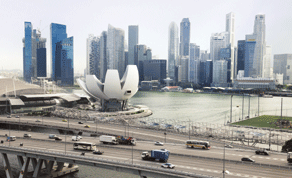
Buildings standing in the skyline of Singapore. Singapore, Malaysia and Taiwan are the Asian economies that are most exposed to growth in North America and Europe. But the region’s biggest economies China, India and Indonesia are mostly driven by domestic demand
Many economists had already trimmed their 2011 and 2012 growth forecasts for China, India and some other Asian economies in a Reuters poll in late July before the US credit rating was downgraded, reckoning that policy tightening to tackle inflation made a slowdown in growth seem inevitable.
But they are holding off on further downgrades at the moment despite heavy selling in global financial markets in recent sessions which could deal a further blow to business and consumer confidence.
“We haven’t changed any forecast at the moment. The impact (of the market turmoil) for us is more on policy than on growth,” said Paul Cavey, an economist at Macquarie.
Global market volatility is likely to prompt Asian central banks to put the policy tightening cycle that mostly began in early 2010 on hold for now, even though some still face stubbornly high inflation levels.
Economists said only a deep global recession of the kind seen in 2008 and 2009 following the financial crisis would prompt them to slash growth forecasts for Asia.
Still, they said that emerging Asia was better prepared than it was in 2008 to handle a downturn should the West plunge into another recession, in particular as Chinese domestic consumption is increasingly outpacing the importance of exports to the US and Europe.
“Chinese reliance on net exports for growth has declined since the onset of the global financial crisis. Domestic demand accounts for nearly all of China’s growth these days,” said ANZ economist Paul Gruenwald.
Other Asian economies have also increased their exposure to Chinese growth rather than Western markets through stronger intra-regional trade.
“Asian demand for Asian products remains robust,” said Gruenwald.
Australia’s Trade Minister Craig Emerson said yesterday that China will need large quantities of Australian raw materials consumed by its break-neck industrialisation and urbanisation.
Singapore, Malaysia and Taiwan are the Asian economies that are most exposed to growth in North America and Europe. But the region’s biggest economies China, India and Indonesia are mostly driven by domestic demand.
Economists at Barclays Capital said in a recent note that for each percentage point of lower growth in the US they would lower their growth forecasts for India and Indonesia by 0.1 percentage points and for China by 0.2 percentage points,
They expect emerging Asia to grow 7.8% this year, predicting a pick-up in global growth later in the year, with expansion of 7.4% in 2012.
While financial markets have been in turmoil this week, it is far from certain that the real global economy will slip back into recession. Even if it does, experts say Asia has lost none of its ability to get quickly on its feet again once conditions being to improve.
“It’s not that Asia won’t be affected, it’s just that it will bounce back quite quickly,” said Gareth Leather, Asia economist at Capital Economics.
The features that helped the V-shaped recovery after the 2008 global crisis remain in place.
Government debt levels in the region have risen due to the stimulus programmes that helped the recovery but still remain low, in particular if compared to the high debt levels haunting European and US government officials.
With the notable exception of India, government debt of most Asian emerging economies stands at below 50% of GDP.
The region’s banking sector is still little dependent on global wholesale banking markets for funding.