


Bloomberg/Dubai
Saudi Arabia pumped the most oil in three decades last month, reaching 9.8mn bpd and boosting Opec production, the International Energy Agency said. Increased output in Angola helped replace lower supply in Libya.

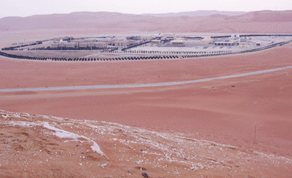
A view of Saudi Arabia’s Shaybah oilfield. Saudi, Opec’s top producer, has replaced almost 70% of lost Libyan crude. The Kingdom will boost output further to ship an extra 3mn barrels of oil to India in August to compensate for lower Iranian supplies
Daily supply from the Organisation of Petroleum Exporting Countries’ 12 members rose to 30.05mn bpd in July from 29.94mn in June, the Paris-based IEA said yesterday in its monthly oil market report.
“Output has regained levels close to those seen before the Libyan crisis, although Opec spare capacity now stands at only 3.3mn barrels per day,” the IEA said. Production is still below what the market demands, even as Saudi Arabia ramps up output to the highest level since 1981.
Saudi Arabia, Opec’s top producer, has replaced almost 70% of lost Libyan crude, the IEA said. The Kingdom will boost output further to ship an extra 3mn barrels of oil to India in August to compensate for lower Iranian supplies.
Output in Iran, Opec’s second-biggest producer, fell to the lowest in more than eight and a half years, dipping to 3.53mn bpd, the IEA said. Exports to India were reduced by a seven-month dispute over payments.
Libya’s daily production slumped by a further 20,000 barrels in July to 60,000 barrels. Output is now reportedly entirely shut in, down from about 1.6mn barrels of daily output at the end of last year, due to violence between anti- government rebels and forces loyal to Muammar Gaddafi.
Angola pumped 1.66mn bpd in July, its highest output in a year, after completing maintenance on fields, the IEA said. Capacity may rise to 2mn bpd by the end of the year as new projects begin producing, according to the report.
Output from the 11 members bound by quotas rose to 27.37mn bpd in July from 27.22mn in June, the IEA said. That implies a compliance rate of 40% with Opec’s production targets, compared with 43% in June.
Opec, provider of about 40% of the world’s crude, set its biggest-ever supply cuts in late 2008 amid a collapse in global demand. The decision capped production at 24.845mn bpd for all members except Iraq, which is exempt from the quota system. Members have largely exceeded quotas this year as they sought to take advantage of higher global crude prices earlier this year and to make up for the lack of Libyan crude.
Compliance percentages are based on combined output from the 11 members that committed to reduce from a base production rate in September 2008 of 29.045mn bpd. Opec’s members are Algeria, Angola, Ecuador, Iran, Iraq, Kuwait, Libya, Nigeria, Qatar, Saudi Arabia, the UAE and Venezuela.
Page 38
Non-oil exports jump 26%
Saudi Arabia’s non-oil exports surged 26% to 14.1bn Saudi riyals ($3.76bn) in June, from 11.2bn riyals in the year-earlier period, data from the Central Department of Statistics and Information (CDSI), showed yesterday.
The kingdom’s imports in June also rose 5% in value to 35.9bn riyals compared with the corresponding period in 2010, according data posted on the CDSI website.
The Kingdom’s main imports were electrical appliances, transport vehicles and food products. Saudi’s main non-oil exports during the period were petrochemicals, plastics, and metals, with petrochemical products worth 5.5bn riyals, accounting for 37% of total non-oil exports.
China was the top importer of the kingdom’s non-oil goods in June, followed by the UAE, Singapore, India and Belgium, according to the CDSI.
The top exporters to the kingdom, the Arab world’s largest economy, were China, the US, Germany, South Korea, and Japan.