Bloomberg/Dubai
After three years of renting a villa in Dubai, French engineer Philippe Bakhos decided to buy.

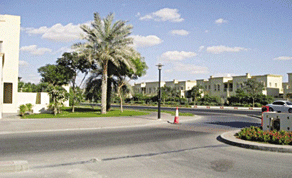
“The Springs,” development in Dubai about 20km from the centre of the city. Dubai’s home prices are expected to decline further as 54,000 homes, or about 15% to 20% of the existing supply, comes onto the market from 2011 to 2015, Jones Lang LaSalle Inc estimates
The 38-year-old is taking advantage of some of the lowest interest rates ever offered in the UAE to purchase a three-bedroom villa for 2.5mn dirhams ($680,661) in “The Springs,” a development about 20km from the centre of the city. Bakhos went to Barclays and HSBC Holdings before securing a 2mn-dirham mortgage from Mashreqbank, a local lender.
“With property prices and interest rates so low, it makes sense to buy,” the father-of-two said in an interview. “With the money I’m spending in rent each month, I can make repayments on a mortgage.” International and local lenders are cutting mortgage rates to attract expatriates such as Bakhos amid signs house prices in the emirate may be bottoming out after dropping 64% from their peak in the middle of 2008. Dubai-based property agent Better Homes says home sales rose to a seven-month high of 116 in July, typically the slowest time of the year, from 38 in January.
Mashreq, controlled by the Al-Ghurair family, is offering Bakhos a 5.49% interest rate and an 80% loan-to-value ratio with no early payment penalty. The same villa cost 4.4mn dirhams at the height of Dubai’s property boom, according to Better Homes.
Standard Chartered is offering some of the lowest interest rates in the UAE at 4.99%. HSBC Bank Middle East, the Dubai-based unit of HSBC, Europe’s biggest bank, has cut mortgage rates to as low as 5.49% from a high of 9.5% in 2009. Rates at Barclays range from 5.35% to 7.75% depending on the loan-to-value ratio.
In the US, the average rate on a 30-year fixed mortgage fell to 4.37% from 4.45% a week ago, the Mortgage Bankers Association said today. That’s the lowest since November.
“Banks weren’t booking significant volumes at the higher levels so slashing their rates means they’ll start to compete,” said Raj Madha, a Dubai-based analyst at Rasmala Investment Bank Ltd. “With the labour market stabilising and property prices beginning to find a floor, banks are realizing that mortgages are a comparatively safe place to lend.”
The three-month Emirates interbank offered rate, the level at which banks in the UAE lend to each other, has dropped 31%, or 66 basis points, since the beginning of April, to 1.47% on Monday, the lowest since Bloomberg began collecting data in September 2006. The rate reached 4.79% in October 2008 after the collapse of Lehman Brother Holdings triggered the worst economic slump since the 1930s Great Depression.
“It’s not surprising that rates are coming down because EIBOR rates have eased this year,” said Shabbir Malik, UAE banking analyst at investment bank EFG Hermes. “The UAE’s banking system as a whole has become more liquid.”
The extra yield that investors demand to hold Dubai government bonds over US government securities quoted at 316 basis points, compared to 118 basis points for Abu Dhabi and 137 basis points for Qatar, Bloomberg data shows.
One-year interbank interest rates were at 1.93% in the UAE, compared to 0.85% in Saudi Arabia and 1.31% in Qatar, according to data compiled by Bloomberg.
International lenders are looking to capture market share from local mortgage providers such as Tamweel and Amlak, which provided almost 90% of all mortgages in the UAE by mid-2008. Both companies halted lending in October 2008 after the property market collapsed.
Tamweel resumed operations in November and now offers a 25-year, 80% Islamic mortgage at 5.25% profit rate to buyers in selected areas.
Overseas banks may be able to take business from domestic firms because their cost of funding is lower, allowing them to offer cheaper mortgage rates, Malik said.
“Rates offered are a function of the cost of borrowing for the bank,” said Thimal Parera, Barclays’ product director of consumer banking in Dubai. “Current rates in the market reflect the lower cost of borrowing prevailing in the market.” International banks may also be boosting mortgage lending after regulators limited personal loans, according to Varun Sood, acting chief executive officer of Tamweel.
In February, the UAE’s central bank capped personal loans at 20 times a borrower’s monthly salary to control lending and curb charges.
Property prices in Dubai, the second largest of the UAE’s seven emirates, have still dropped 64% from their peak in mid-2008, while rents have fallen 55%, Deutsche Bank AG said.
Mortgage demand has plummeted since the days of Dubai’s property boom, when speculators bought yet-to-be-built homes and sold them at a profit before a single brick was laid. The number of mortgage transactions was at 396 worth 1.5bn dirhams last month compared with 698 transactions worth 6bn dirhams in July last year, according to Reidin.com, a research firm that tracks the UAE real-estate market.
Dubai’s home prices are expected to decline further as 54,000 homes, or about 15% to 20% of the existing supply, comes onto the market from 2011 to 2015, Jones Lang LaSalle Inc estimates. The impact of lower interest rates and new visa laws isn’t expected to kick in until later in the year, analysts said.
Nonperforming loans at banks in the UAE are expected to peak at about 12% this year from 8% to 10% in 2010, Moody’s Investors Service said March 7.
“Any risk of fierce rates competition between banks is compensated by the renewed interest this competition is creating in the real-estate market,” said EFG’s Malik. “This should stabilise the real-estate market and as a result reduce the risk of non-performing loans for all banks.”
Most of the mortgage transactions last year were to refinance existing loans, while the majority of loans this year are for new purchases, analysts said.