AFP/Frankfurt
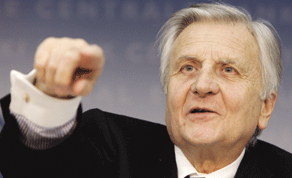
European Central Bank chief Jean-Claude Trichet yesterday called on European governments, notably Italy and Spain, to “do their duty” in reducing public deficits and stabilising their finances.

Trichet: ... since the fall of Lehman Brothers, this is the worst crisis since the Second World War
“In sum, since the fall of Lehman Brothers, this is the worst crisis since the Second World War,” Trichet warned on Europe 1 radio, referring to the collapse of the US investment bank in September 2008 that triggered a global financial crisis.
In this context “we expect governments to do what we consider to be their work, their duty,” Trichet said.
“We have been extremely clear with the Italian government over recent days in asking for a number of decisions to be taken, which have been taken, and to speed up in particular a return to a normal budgetary situation,” he said.
“We have asked the same thing of the Spanish government. We have asked European governments as a whole, 17 of them, to speed up the decisions taken on July 21 during a eurozone (summit) meeting,” he added
The ECB said on Monday it would resume purchases of eurozone government bonds so as to ease the pressure on the weakest, notably Italy and Spain, whose borrowing costs soared to unsustainable levels in recent weeks.
Yesterday, the pressure eased further on Italian and Spanish bonds but stock markets globally were down very sharply, reflecting growing nervousness over the economic outlook as a litany of bad news continued to pour in.
Trichet said governments should put the decisions taken at last month’s eurozone summit into action “as quickly as possible.”
“There’s the reduction of countries deficits, there’s the fast implementation of decisions taken there,” and especially on allowing the European Financial Stability Facility (EFSF), the eurozone rescue fund, to intervene in the secondary bond markets, Trichet said.
Among the decisions taken at the Brussels meeting was the buying up of troubled members’ government debt by the EFSF
“We have asked them to confirm that they were in effect a financial stabilisation fund which could intervene on the secondary markets as quickly as possible,” Trichet said.
The parliaments of the countries concerned must first approve the move, a process which could take several weeks and so the ECB had to step into the breach, announcing on Monday it was to “actively” intervene in the markets by buying government bonds.
Trichet once again defended the decision but did not say which bonds or what sums were involved, as per standard ECB practice.
The ECB chief said the amount would be given next Monday.
Meanwhile, the parliamentary leader of Chancellor Angela Merkel’s coalition allies said Germany’s lower house of parliament could push for the package arising from last month’s emergency European summit to be amended.
Many Germans resent funding bailouts for eurozone partners flouting European fiscal rules, and lawmakers from Merkel’s own coalition are increasingly vocal about their fears of the bloc turning into a transfer union funded by its largest economy.
“I can imagine the Bundestag will indeed push...for these (decisions) to be improved further,” the parliamentary leader of the Free Democrats Rainer Bruederle said yesterday.
His comments come right after Merkel on Sunday issued a joint statement with French President Nicolas Sarkozy stressing the importance of obtaining swift parliamentary approval for the decisions made at the summit on July 21.
“Not everything is perfect,” Bruederle said, commenting on the new aid package for debt-stricken Greece and the tightening of the stability pact.
“Germany’s budget cannot simply be turned into a self-service shop for other countries while the core problems are not tackled sufficiently,” he added.
Some rebel lawmakers in Merkel’s coalition have expressed frustration with her policy on Europe, but senior lawmakers this week scoffed at the prospect of a Bundestag veto of the package.
Bruederle also feared that the turmoil on both sides of the Atlantic would overcast the growth prospects of Europe’s largest economy. “There is this risk,” he said.