Reuters/Brasilia/Sao Paulo
Brazil’s government has granted more than $25bn in new financing and tax breaks to local factories struggling with an overvalued currency, imports from China and signs of a broader economic slowdown at home and abroad.

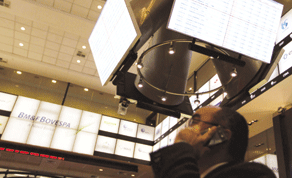
A man talks on his mobile phone as he looks at an electronic display board at Brazil’s Bovespa stock exchange in Sao Paulo. The Brazilian government has granted more than $25bn in new financing and tax breaks to struggling local industries
The long-awaited plan, known as ‘Bigger Brazil’, seeks to address a potentially dangerous imbalance: Although credit and commodity exports continue to drive robust overall economic growth in Brazil, many factories are seeing their output and profit shrink, prompting worries of a longer-term malaise.
Despite concerns that the new measures could fuel inflation or erode the government’s finances, Finance Minister Guido Mantega said factories clearly needed urgent help – especially as the global economy slows again and faces new threats from the US and European debt crises.
The measures included 25bn reais ($16bn) in tax breaks for targeted industries such as shoe makers and software companies; 7bn reais in new financing via the BNDES state development bank; and the creation of a new export financing facility, among other steps.
Mantega said Brazilian manufacturers are also struggling to compete internationally because larger economies, including the US, are “artificially” weakening their currencies in order to make their own exports cheaper.
Brazil’s real has gained 6% against the dollar this year and is the world’s most overvalued currency by some measures. Nearly half of the country’s exporters have lost market share in the past year, according to a poll released this week by the CNI industry group.
“We’re seeing predatory competition at a global level,” Mantega told officials and industry leaders who gathered for the formal announcement. “This crisis scenario especially damages the manufacturing sector.”
Overall, the plan was a hard-fought compromise between industrial leaders who clamored for larger tax breaks, and fiscal hawks within President Dilma Rousseff’s government who are worried about inflation and hitting a budget deficit target for this year that is closely watched by investors.
The reception from local industries was lukewarm.
“It’s a good start,” said Paulo Skaf, the president of the Fiesp industry association.
“It’s logical that we would have liked to see all (industrial) sectors have payroll tax breaks. But it’s a start in these sectors with intensive labour. We hope that it (eventually) extends to other sectors,” Skaf said.
The announcement coincided with data showing that industrial production fell more than expected in June, down 1.6% from the previous month. Manufacturing output in Brazil has been mostly flat for more than a year despite a robust economic expansion.
“This could provide some relief, but it won’t change the overall trend,” said Zeina Latif, senior Latin America economist with RBS in Sao Paulo. “Investment decisions are more complex.”
While global trends, including the weak US dollar, have played a major role in the struggles of Brazilian industry, local factors have also weighed.
Terrible infrastructure, one of the developing world’s highest tax takes and expensive labour costs contribute to what is known locally as the “Brazil cost” – the unusually high prices of domestic goods. For example, even a basic two-door new car can cost upward of $30,000, nearly twice the level in the US.
Rousseff’s government has shown little interest in structural reforms, such as a revision of the tax code, that could make industries substantially more competitive.
The plan establishes new advantages for local manufacturers on government procurement contracts, which is big business in Brazil, especially as the country expands its infrastructure ahead of the 2014 World Cup and 2016 Olympics.
To help provide financing for manufacturers, the government said it would also extend an existing 75bn reais ($48bn) credit line to the BNDES state development bank until the end of next year – a move that could prove controversial.
Some economists say Brazil’s reliance on the BNDES creates inflationary pressures and distorts credit markets by crowding out private-sector lenders.
Trade and Industry Minister Fernando Pimentel also said the government would focus on better control of Brazil’s borders in order to catch counterfeit goods coming from China – although customs officials have said they need more financial resources in order to accomplish that goal.