Agencies/Dubai
Most stock markets in the Gulf region tumbled yesterday as a downgrade of US government debt by ratings firm Standard & Poor’s triggered investor concerns about the health of the world’s biggest economy and the outlook for global growth.

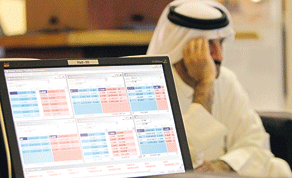
An Emirati investor reacts as he follows the stock market developments at the Dubai Financial Market yesterday. Dubai’s benchmark endured its biggest drop since January 30 closing at a 20-week low, down 3.7% to 1,484. Bluechip Emaar Properties ended down 5.3%
The downgrade hit Saudi Arabia’s market hard on Saturday, sending the Arab world’s largest bourse to a five-month low. Weakness spilled over into the rest of the Gulf Arab region, where all but one Gulf state pegs its currency to the dollar.
The hydrocarbon-reliant Gulf Arab states are major holders of US treasuries and other US assets.
“The US economy has certainly slowed recently and the European sovereign debt crisis is still far from over,” said Akber Khan, director of asset management at Al Rayan Investment in Doha. “The last three years have underlined the linkages within the global economy so it is unreasonable to expect the rest of the world to be completely immune from disruptions in Europe and the US”
A steady opening in Saudi Arabia, which starts two hours after the first Gulf markets begin trading, helped staunch the decline elsewhere on Gulf markets yesterday.
But early damage was done with Dubai’s benchmark enduring its biggest drop since January 30. Dubai closed at a 20-week low, slumping 3.7% to 1,484.
Bluechip Emaar Properties ended down 5.3%, Arabtec sagged 6.3% and Dubai Financial Market closed off 5%.
Oman’s index ended at a two-year low, down 1.9% at 5,651%. Bahrain fell 0.33% to 1,277% while Abu Dhabi ended at a May 26 low, down 2.5%. Kuwait ended 1.6% lower at 5,968 points.
“The global story is looking increasingly less optimistic, and at the same time you have equity markets here that have been relatively less volatile for a considerable stretch,” said Akram Annous, Dubai-based Mena strategist at Al Mal Capital. “That’s probably going to start to change now, and I think the majority of the risk is in Saudi Arabia and Qatar’s markets because they are more leveraged to the (emerging market) growth story.”
Saudi Arabia’s index ended up 0.08% at 6,078 points.
“Today is a stemming of the bleeding, but things are still unknown. There are a lot of questions, on how the downgrade could affect the Saudi development plan,” said a Riyadh-based fund manager who asked not to be identified.
Gulf Arab officials remained noticeably silent yesterday on S&P’s decision to downgrade the US, but analysts said the move would still likely have implications on the region’s economies, especially if the US economy were to slow markedly.
“It’s hard to see any decoupling for the regional markets from the global economies. Any global slowdown in the US and Europe will certainly weigh on the regional economies,” said Rami Sidani, head of investment at Schroders Investment Management for the Middle East and North Africa.
Despite yesterday’s sharp retracement, some analysts said the pullback offers a buying opportunity and doesn’t signal a return to market levels seen at the height of the financial crisis in 2008.
“We would view any weakness in the markets as a buying opportunity as we see the current environment as being fundamentally different to that of 2008, where Mena markets fell in line with global markets but then failed to register a concomitant recovery,” strategists at Religare Capital Markets said in a note to clients.
Investors were eyeing today’s opening of global markets with trepidation. Regional bond prices had begun to ease on Friday and a further sell-off is expected.
The spread on HSBC/Nasdaq Dubai’s Middle East bonds and sukuk index widened about 30 basis points between August 3 to 5.
“Shorter-dated local bonds and sukuk should hold up relatively well because of local demand,” said Nick Stadtmiller, fixed income analyst at Emirates NBD in Dubai. “But longer-dated bonds will have a harder time, as international investors are key buyers of this paper.”
The US dollar may weaken and Treasury yields rise when Asian markets reopen today, though any selling in response to the US downgrade is likely to be tempered by the escalating crisis in the eurozone. The European Central Bank was slated to discuss the debt crisis in an evening conference call.