


AFP/Tokyo
Japan led Asian governments in seeking to calm fears over the American debt downgrade yesterday, saying Tokyo’s trust in US Treasuries remained unchanged.

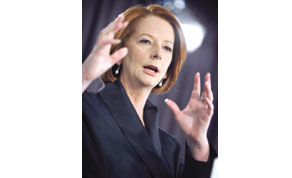
Gillard: ‘... look at all of the facts
Standard & Poor’s has cut the US rating a notch from the top flight triple-A to AA+, saying its politicians were becoming less able to get to grips with the country’s huge fiscal deficit and debt load.
But Japan, the second largest holder of US debt after China, said the move would not affect its confidence in US government bonds, while Australia and South Korea warned against over-reacting to the downgrade.
“The trust we have in US Treasuries and their attractiveness as an investment will not change because of this action,” an unnamed senior Japanese government official told Dow Jones Newswires.
Another official also said that Japan’s investment policy regarding its foreign reserves remains unchanged, the newswire said.
Japan is unlikely to sell any of its dollar-denominated assets as it is fighting to stem the yen’s rise to near a record-high against the greenback.
S&P gave a negative outlook for the US, saying there was a chance its rating could be cut again within two years if progress is not made cutting the government budget gap.
The downgrade followed days of heavy losses on stock markets around the world, as investor confidence was hammered by fears for the US economy and a warning from the head of the European Commission that the eurozone debt crisis had likely spread.
South Korea held an emergency meeting of senior finance ministry officials yesterday to discuss possible fallout from the downgrade, but warned against over-reaction.
“There is possibility that South Korea’s economy might be affected in the short term,” Vice Finance Minister Yim Jong-Yong said after the meeting.
“However, there is no need to be concerned excessively about our economy and financial markets.”
Yim also called for talks with policymakers from the central Bank of Korea and financial watchdog bodies today to discuss what actions Seoul should take ahead of markets reopening tomorrow.
Australian Prime Minister Julia Gillard also urged a measured response to the downgrade, pointing out that it was not unexpected and the two other key agencies still rated US debt at top grade.
“Standard and Poor’s had been signalling for some time that unless they saw a certain figure of budget cutbacks out of the discussion that there’s been in Washington about the American budget and fiscal consolidation, that they were intending to do that downgrade,” she said.
“At the same time, the other two major ratings agencies, Moody’s and Fitch, continue to have the American economy rated at AAA. So I think people just need to look at all of the facts.”
Australian stocks plunged 4% on Friday, the worst losses seen in a single session since the height of the 2008 financial crisis, but Gillard insisted yesterday the country’s economic fundamentals were strong and could weather any financial storms that were brewing.
In Kuala Lumpur, Yeah Kim Leng, a senior economist with financial research firm RAM Holdings, said he expected Asian market reaction to S&P’s move to be “muted” as the downgrade had already been priced in.
“Of course globally there is greater uncertainty now... There will be some investors who follow a ‘triple A’ credit rating who need to sell-off ... So the market will see some adjustments,” Yeah said.
He said he expected Asian countries to hold on to their US dollar reserves amid “few available alternatives”, describing Asia as a “relative sea of stability” compared to the volatile European and US markets.
The Philippines said the downgrade would serve as a “wake-up call” but it was confident the world’s largest economy could address its problems.
President Benigno Aquino’s spokesman Ricky Carandang said: “In a way it’s a wake-up call for the US to begin to seriously address its economic issues. We’re confident they will be able to do this.”
He added that the country was closely monitoring the US debt crisis after Washington lost its top-notch AAA credit rating for the first time ever, but that it was too early to tell what the effect would be on Manila.
According to US Treasury data, the Philippines holds $23.6bn in US securities, now rated AA+ by S&P with a negative outlook.
The US is also its top export market, main provider of foreign military aid, and a key host for the Philippines’ ninemn-strong overseas workers.
A presidential spokeswoman, Abigail Valte, said on government radio that Aquino’s top economic advisers were closely watching the potential fallout.
“The economic managers are closely watching the developments. It is too early to tell what the impact will be. We will take the necessary steps to address this,” Valte added.