


Bloomberg/Singapore
Asian stocks fell yesterday, recording the biggest two-day drop since March, as exporters tumbled after rating agencies warned the US may be downgraded and an unexpected decline in consumer spending increased concern that growth in the world’s largest economy is faltering.

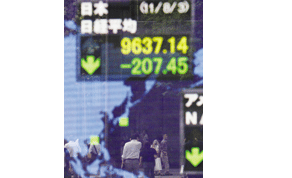
Pedestrians are reflected on an electronic stock board displaying the closing figure of the Nikkei in Tokyo yesterday
The MSCI Asia Pacific Index dropped 2.3% to 133.52 in Tokyo, taking its two-day decline to 3.9%, the steepest since March 15. The gauge also fell on Tuesday after a report showed the slowest US manufacturing growth in two years, overshadowing a deal among lawmakers to raise the country’s debt limit to avoid a default.
“With the debt-ceiling issue out of the way, stock markets are focusing on the fundamentals of the US economy, which don’t look encouraging,” said Prasad Patkar, who helps manage the equivalent of $1.7bn at Sydney-based Platypus Asset Management Ltd.
“It’s too early to tell if this is an air pocket through which the US is passing or something more nasty, but the performance of the global economy will be lackluster at best if the US ends up in another recession.”
The odds of another US downturn are rising amid cutbacks in spending by consumers and the government, according to five of the nine members of the US panel that dates recessions.
Japan’s Nikkei 225 Stock Average slid 2.1% yesterday and South Korea’s Kospi index decreased 2.6%. Australia’s S&P/ASX 200 Index fell 2.3% as the nation’s retail sales unexpectedly declined in June for a second straight month.
Hong Kong’s Hang Seng Index retreated 1.9% as banks including HSBC Holdings and Industrial & Commercial Bank of China Ltd dropped.
Moody’s Investors Service and Fitch Ratings affirmed their AAA credit ratings for the US while warning that the ratings could be downgraded if lawmakers fail to enact debt reduction measures and the economy weakens.
Li & Fung Ltd, the world’s biggest supplier to retailers including Wal-Mart Stores, slumped 5% to HK$12.30, set for the lowest close since Aug. 12, 2009, in Hong Kong.
James Hardie Industries, an Australian building-materials company that gets almost 70% of its sales from the US, slipped 4.6% to A$5.43 in Sydney.
BHP Billiton, the world’s largest mining company, slid 3.4% in Sydney to A$40.15 after copper futures for September delivery declined for the second straight day yesterday in New York.
Rio Tinto Group, the world’s second-biggest mining company by sales, fell 3.1% to A$77.60.
Steel makers in Asia also slumped. BlueScope, Australia’s biggest, plunged 5.4% to A$1.05 in Sydney, while Posco, South Korea’s largest, dropped 1.8% to 461,500 won in Seoul. JFE Holdings Inc sank 3.3% to ¥2,023 in Tokyo.
“Concerns about a slowdown in the US economy are increasing,” said Hiroichi Nishi, an equities manager in Tokyo at SMBC Nikko Securities. “Growth in personal income is weak and money is not flowing into spending that drives the US economy.”
In Tokyo, Mitsubishi Corp, a Japanese trading house, sank 1.9% to ¥2,001, while in Hong Kong, Chinese offshore oil and gas producer Cnooc fell 2.8% to HK$16.92.
Honda dropped 3.2% to ¥3,010 in Tokyo. Canon, the camera maker that gets more than 80% of its revenue abroad, slipped 1.7% to ¥3,690. Samsung Electronics sank 2.2% to 833,000 won in Seoul.
“The US remains the world’s largest economy and consumer activity will remain a key piece of the global puzzle,” said Michael McCarthy, Sydney-based chief market strategist at CMC Markets Asia Pacific Pty Ltd. “Investors’ focus remains negative, moving from resolution to the next concern without pause.”
Australian retailers fell after the Bureau of Statistics said retail sales unexpectedly declined in June for a second straight month as spending at department stores dropped by the most since April 2010.
Harvey Norman Holdings Ltd, the nation’s biggest electronics retailer, sank 2.3% to A$2.10. David Jones Ltd, Australia’s second-largest department-store chain, slipped 0.3% to A$2.99 in Sydney.