Reuters/Singapore
China’s factory activity slowed down in July and by one measure contracted as manufacturing across much of Asia weakened on signs that global demand is losing momentum.

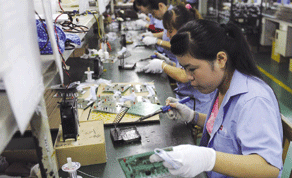
An employee works on circuit boards at an electronic component factory in Hefei, Anhui province, yesterday. China’s factories struggled with their weakest activity in 28 months in July, a pair of surveys showed yesterday, as manufacturers grappled with credit shortages and softening global demand
Shrinking order books sent the eurozone’s manufacturing sector into effective stagnation in July, purchasing managers’ indexes showed. The sector in the euro currency zone grew at its weakest pace since the region emerged from recession.
Manufacturers in the eurozone’s Franco-German core expanded at a slower pace last month, having long propped up growth among eurozone factories at large, while the sharp declines seen in Spain during May and June deepened in July.
The Markit Eurozone Manufacturing PMI, which measures changes in the activities of thousands of eurozone manufacturers, fell to 50.4 in July from 52 in June – unrevised from the preliminary reading of 50.4.
PMIs from HSBC showed manufacturing sectors in China, Taiwan and Russia contracted. Factories expanded in India, but at their slowest pace in 20 months.
The PMI in debt-laden Ireland pointed to the second month of contraction in the manufacturing sector, while South Korea headed in the opposite direction by showing growth picked up for the first time in seven months.
In China, the HSBC PMI fell to 49.3 points in July from 51.6 in June, falling below the 50 mark that divides growth from contraction for the first time in a year as tight monetary policy and weak global demand weighed.
However, a Chinese government PMI showed that the country’s vast manufacturing sector expanded in July, but at its slowest pace in more than two years. The index fell to 50.7 from 50.9 in June.
The HSBC PMI is tilted towards the private sector, which has been hit harder by tightening monetary conditions in China, while the official PMI leans towards measuring large state-owned firms that have better access to bank loans.
India’s factory sector growth slowed down in July for the third month in a row. The HSBC PMI dropped to 53.6, from 55.3 in June, the lowest level since November 2009.
The indexes added though to worries that sovereign debt in major demand centres such as Europe and the US is weighing on their economic recoveries from the global financial crisis.
New export order growth in China, the world’s biggest exporter, hit its lowest level in 17 months, the official survey showed.
But HSBC said new export orders in India fell in July at their fastest pace in 29 months and in Taiwan, home to the world’s two biggest contract chip makers, they fell markedly and for the first time in nine months.
“There is still a lot of uncertainty about how global demand will hold up,” said Vishnu Varathan, economist at Capital Economics in Singapore.
Asia ex-Japan currencies received a boost from the China and Korea PMI data as the market perceived the economies were no where close to a hard-landing.
The Malaysian ringgit rose while the South Korean won and the Philippine peso raced to three-year peaks.
Hedge funds have been buyers of emerging Asian currencies on hopes for a US debt deal and data showing strong economic growth in the region.
Taiwan’s July PMI signalled a second consecutive month-on-month reduction in manufacturing sector output and the steepest contraction since January 2009, as new orders continued to decline.
South Korea’s manufacturing sector growth accelerated for the first time in seven months in July and new export orders also picked up, the HSBC survey showed.