Reuters/Athens/Berlin
Greece’s embattled prime minister sacrificed his finance minister yesterday to force through an unpopular austerity plan and avert bankruptcy, while EU powers Germany and France promised to go on funding Athens.

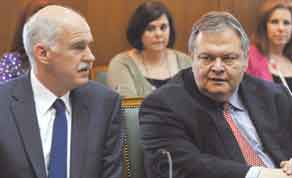
Greece’s Prime Minister George Papandreou (left) talks with newly appointed Finance Minister Evangelos Venizelos before a cabinet meeting at the parliament in Athens yesterday. The socialist heavyweight is the second-best choice after Papandreou failed to persuade former ECB vice-president Lucas Papademos to come aboard, according to analysts
After a week of political turmoil and violent protests in Athens, Prime Minister George Papandreou put his main socialist rival into the finance ministry in a bid to unite his fractious party behind spending cuts, tax rises and privatisations crucial to securing further IMF/EU assistance.
In Berlin, the leaders of Germany and France, long at odds over how to involve private holders of Greek bonds in a new rescue package for Athens, said they agreed on a mild solution favoured by Paris and the European Central Bank.
The outline agreement between Chancellor Angela Merkel and President Nicolas Sarkozy on a second bailout package boosted the euro and reduced risk premiums on Greek and other peripheral eurozone bonds after a week-long financial rout.
“France and Germany want a new programme in place as soon as possible. There is no time to lose,” Sarkozy told a joint news conference with Merkel.
New Greek Finance Minister Evangelos Venizelos, promoted from the defence ministry with the extra status of deputy prime minister, said in his first statement to reporters: “The country must be saved and will be saved.”
Analysts said the socialist heavyweight was a second-best choice after Papandreou failed to persuade respected former ECB vice-president Lucas Papademos to come aboard, but it enabled him to dump several ministers who had obstructed reforms.
Outgoing Finance Minister George Papaconstantinou, who negotiated a first €110bn bailout for Athens last year and had the confidence of international lenders and markets, was moved to the environment ministry in a crisis-driven reshuffle.
“Venizelos is politically powerful and that might bode well for the implementation of fiscal consolidation, even though he has no track record in financial matters,” UBS analyst Alexander Kyrtsis said.
Papandreou will seek a parliamentary vote of confidence in the new cabinet next Tuesday after a debate starting on Sunday.
Greek market reaction was positive with bank shares rising nearly 8% and the Athens stock market index climbing almost 4%.
Bond markets remain spooked by fears of a Greek default and most economists are overwhelmingly sceptical that Greece can ever repay its debt mountain, which has reached €340bn or 150% of the country’s annual economic output.
Reuters’ calculations based on 5-year credit default swap prices from Markit show an 81% probability of Greece eventually defaulting based on a 40% recovery rate.
The ECB and the European Commission have warned that any form of private sector involvement that causes a “credit event” or a downgrading of Greek debt to default status could wreak devastating damage on the eurozone.
They opposed a plan proposed by German Finance Minister Wolfgang Schaeuble for private holders of Greek debt to swap their bonds for new ones with maturities that were seven years longer, giving Greece extra breathing room.
Merkel backed away from that idea yesterday, saying she now believed a softer option based on the 2009 Vienna Initiative—a voluntary deal by banks to maintain their exposures in eastern Europe at the height of the financial crisis—was a “good foundation” for a Greek deal.