AFP/Frankfurt
European Central Bank president Jean-Claude Trichet cited US founding father Alexander Hamilton yesterday in calling for stronger economic governance for the crisis-hit eurozone.

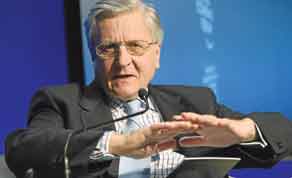
Trichet: European Central Bank is stressing tirelessly the necessity of strongly reinforcing the euro area economic governance
“We should ourselves ‘learn to think (more) continentally’,” Trichet told a Frankfurt conference of analysts and other ECB observers, quoting Hamilton, who established the first US national bank.
The ECB president recently floated the idea of a finance minister for the 17 countries that share Europe’s single currency, a long-term project aimed at enforcing co-ordination of fiscal policies among widely disparate economies.
“Governing these very vast and equally diverse economies with a single currency is more of a challenge in a union of sovereign states than in a political federation,” Trichet noted in comments distributed ahead of his speech.
“That is the reason the European Central Bank is stressing tirelessly the necessity of strongly reinforcing the euro area economic governance.”
Trichet has repeatedly called on eurozone political leaders mutually to strengthen economic policies to complement the monetary union managed by the central bank.
The ECB currently is in disagreement with Germany in particular over how best to help fund a second Greek rescue plan, to which Berlin wants a contribution by private investors.
Central bank directors warn that could cause a collapse of some Greek banks, which own much of the country’s debt, and undermine confidence in the financial sector, with unpredictable consequences for the eurozone as a whole.
The bank has been providing hundreds of billions of euros via controversial bond purchases and central bank loans to help contain the Greek debt crisis.
Trichet also said the eurozone’s collective public deficit should fall below 3% of output by 2013, an event that would represent a milestone in reining in swollen national budgets.
“Recent forecasts indicate that the euro area as a whole is on track to bring the deficit to GDP ratio below the 3% reference value by 2013 and to stop the adverse debt dynamics caused by the financial crisis,” Trichet told the conference.
Eurozone countries are supposed to maintain public deficits of no more than 3% and work towards a balance or even a surplus in times of economic growth.
But almost all have exceeded that level owing to public spending aimed at buffering economies from the effects of the global economic crisis.
Countries such as Greece, Ireland and Portugal are struggling in particular to cut their deficits, while eurozone powerhouse Germany has passed legislation that requires the government to essentially eliminate its own by 2016.