AFP/Athens
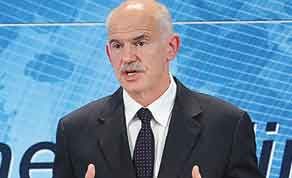
Prime Minister George Papandreou will chair a cabinet meeting today to discuss a new fiscal plan which he says is guaranteed to overcome Greece’s debt crisis without resorting to major structural change.

Papan: Restructuring is not in the discussions. I choose to fight for my country
“We are discussing a four-year programme that guarantees our exit from the crisis and other serious changes, structural. We are talking about a serious and systematic negotiation,” Papandreou was quoted as saying by a Greek newspaper.
The prime minister ruled out a restructuring of Greece’s mountain of sovereign debt which has rocketed to €340bn ($484bn).
“Restructuring is not in the discussions. I choose to fight for my country and that is what I am doing, to save and change Greece,” the Socialist leader said.
The comments come as some eurozone governments are beginning to warm up to the idea of Greece restructuring its debt although the European Central Bank (ECB) is still insisting that a rescheduling would seriously hurt banks in Greece and in other eurozone countries.
Two senior members of the ECB said yesterday in the Greek press that Greece can avoid restructuring its debt if the country sticks to the €110bn EU-IMF bailout plan to the letter.
“If all the points in the programme are implemented, the sustainability of the debt is guaranteed,” ECB executive board member Juergen Stark was also quoted as saying.
“With any type of restructuring, Greece is in danger of failing to tap the markets in a reasonable time, and if it succeeds, it will pay in the future a higher risk margin,” he warned.
Ewald Nowotny, an Austrian member of the ECB governing council, also ruled out the possibility of Greece restructuring its massive debt.
“The ECB has a clear position: this programme (€110bn rescue package) is the route you must follow. I don’t see an alternative plan,” Nowotny said.
German Finance Minister Wolfgang Schauble meanwhile said that any restructuring would require the agreement of the European Central Bank and International Monetary Fund.
“We don’t want to end up in a conflict with the European Central Bank under any circumstances,” Schauble said.
“The experts have to tell us what is going to work and what is not going to work, because that will drive market concern. It’s not going to be easy.”
Schauble was last week considering an agreement with Greece to extend its repayment deadline on the condition that private creditors were involved.
Some eurozone countries have outlined to the government the benefits of reaching a consensus with other political parties, as Portugal did, in an effort to save the country.
The Greek Prime Minister will hold successive meetings with the country’s political leadership tomorrow in order to find common ground.
But reaching a consensus will not be easy.
Antonis Samaras, leader of the main opposition New Democracy party, said he would not vote for a second memorandum or for the mid-term fiscal plan because it “doesn’t include recovery measures.
“I will not vote for any commitment on a wrong and deadlocked policy,” the conservative leader said.
And Communist Party leader Aleka Papariga rejected on Saturday Papandreou’s invitation to meet, saying her party holds a “diametrically” opposite position to that of the Socialist Party.
However, 6 out of 10 Greeks believe the two main parties must focus their efforts in finding common ground according to an opinion poll carried out by MARC institute on behalf of newspaper Ethnos.
Athens last year agreed to overhaul its economy and rein in a huge public debt in return for a €110bn EU-IMF loan that saved the country from default.
Despite a big effort to reduce the deficit last year with draconian measures, Greece’s finances remain at a critical situation and will most likely not be able to return to international markets in 2012 as the government initially intended.