Bloomberg/Paris
Airbus is poised to further lift production of its bestselling A320 jet series as airlines seek more fuel-efficient planes to cope with rising oil prices, helping the manufacturer fund construction of larger aircraft.

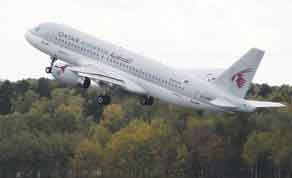
A Qatar Airways Airbus A320 takes off from Tegel airport in Berlin, Germany. The A320 is the main generator of revenue at Airbus, helping finance the new A350 widebody model
Airbus, the largest commercial aircraft maker, is moving toward 40 single-aisle planes each month by next year from 36 now, and a decision on another hike will come within days, said Hans Peter Ring, chief financial officer of Airbus parent European Aeronautic, Defence & Space Co.
“Any production increases on the A320 would be good news, as that brings in more cash,” said Yan Derocles, an analyst at Paris-based Oddo Securities, who has a ”buy” rating on Eads.
The A320 and Boeing Co’s competing 737 are the workhorses of the airline industry. The A320 is the main generator of revenue at Airbus, helping finance the new A350 widebody model. Production could be ramped up to as many as 44 planes, Ring said. A move to 44 would boost earnings by €300mn ($428mn), Derocles said.
“We need to move carefully,” Ring told reporters on a call. “What makes it so difficult to take the decision is clearly we need to deliver on this ramp-up, which is challenging, and we’re depending on our supply chain.”
Both Airbus and Boeing have been ramping up production of their twin-engine, single-aisle models as airlines and leasing companies renew efforts to refresh fleets. Output at Boeing, based in Chicago, is now at 31.5 a month for its 737, rising in two steps to 38 by 2013, and as high as 42 later on.
Airbus, at a monthly rate of 36 since December, will reach 38 by August before moving to 40 in the first quarter of 2012.
Putting more brand-new planes into the market could have a knock-on effect on pricing, given that more relatively-new planes might move into the used market, effectively competing with new production, analysts said.
“It’s certainly is an area of risk,” said Chris Tarry, an independent analyst in London who has followed the industry for almost 30 years. “What happens in the second market is going to have an impact on the primary market.”
For Airbus, more planes means more cash at a time when the development costs of the A350 are draining profit.
The Paris-and Munich-based company yesterday reported a surprise first-quarter loss and cautioned that the A350 programme remains challenging. Eads plans to start assembling the jet by the end of 2011 and have it in service two years later.
First-quarter deliveries fell to 119 planes from 122. Company-financed research and development costs rose to €650mn from €572mn a year earlier as Airbus began producing the first pieces of the long-range A350.
“While advancing with the A350 XWB through achieving several critical milestones, this decisive program continues to require our closest attention,” Eads Chief Executive Officer Louis Gallois said in the statement.
The manufacturer has pushed back the planned first delivery, to Qatar Airways, by several months to late 2013.
The A350 will compete with Boeing’s 777, operating since 1995, and the US company’s smaller 787 model, which is running 3 1/2 years behind schedule. Boeing is aiming for the first deliveries in September of this year.
Airbus is still targeting A380 superjumbo deliveries “in the mid-20s” and reaching 20 is a certainty, Ring said. New aircraft delivered today are achieving a 98% dispatch reliability rate, he said.
Eads’s biggest shareholders include carmaker Daimler, the French state and Lagardere. Over the years, Lagardere has whittled its holdings down to 7.5%, and Daimler has placed a 7.5% Eads stake with a group of German banks and states, while keeping voting control of those shares for a total 22.5% stake in Eads. The French state still owns 15%.