


Bloomberg/Singapore
Asian stock markets fell yesterday, with the key regional index set for its biggest slide since markets crashed in the wake of Japan’s record earthquake in March, as commodity prices tumbled amid concern that China will further tighten monetary policy.

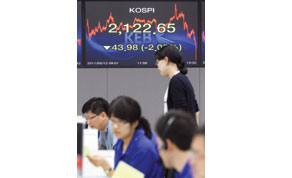
Traders on the floor of the stock exchange in Seoul, yesterday. The benchmark Korea Composite Stock Price Index plunged 43.98 points to 2,122.64 due to foreign investors’ massive sell-offs triggered by worries over commodities price increases
The MSCI Asia Pacific Index declined 1.6% to 136.14 in Tokyo after commodity prices tumbled on Wednesday as China reported faster-than-estimated inflation and as the US Federal Reserve gets closer to ending a $600bn asset-purchase programme, known as quantitative easing, in June.
“Markets always struggle with tightening cycles,” said James Holt, Sydney-based director of BlackRock Investment Management (Australia) Ltd, which oversees about $40bn in assets.
“The China inflation data yesterday shows that the country will need to do more tightening. This comes at the same time as investors pre-empt the end of the second round of quantitative easing, which has pumped up asset and commodity markets.”
The gauge is headed for its steepest drop since March 15, when it fell 5% as Japanese stocks plunged amid a nuclear crisis triggered by a magnitude-9 earthquake and ensuing tsunami on March 11.
Japan’s Nikkei 225 Stock Average fell 1.5% and South Korea’s Kospi Index lost 2%. Hong Kong’s Hang Seng Index retreated 0.9%. Australia’s S&P/ASX 200 Index decreased 1.8% on a day the statistics bureau reported that the nation’s employers unexpectedly cut workers in April by the most since 2009.
The MSCI Asia Pacific Index rose 0.5% this year through yesterday, compared with gains of 6.7% by the S&P 500 and 2.9% by the Stoxx Europe 600 Index. Stocks in the Asian benchmark were valued at 13.6 times estimated earnings on average at yesterday’s close, compared with 13.6 times for the S&P 500 and 11.3 times for the Stoxx 600.
The Asia-Pacific gauge has risen close to 5% and commodity prices have surged since November 3 when a US plan to buy Treasuries was unveiled. The Fed said last month it won’t need to extend the $600bn programme beyond its scheduled end next month.
BHP Billiton, the world’s largest mining company, dropped 2.6% in Sydney after oil and metal prices sank on Wednesday in New York.
BHP Billiton, also Australia’s No1 oil producer closed at A$44.13 in Sydney, while Rio Tinto Group, the world’s No2 mining company by sales, retreated 2% to A$79.79. Jiangxi Copper, China’s No1 producer of the metal, slumped 2.2% to HK$24.10 in Hong Kong.
Olympus Corp, an optical-equipment maker, lost 5.6% in Tokyo after reporting an 85% slump in profit. Korea Zinc slid 5.7% to 367,500 won in Seoul and Mitsubishi Corp declined 2% to ¥2,112 in Tokyo.
“The volatility in commodity prices and concerns about future policy direction in China have increased investor uncertainty,” said Tim Schroeders, Melbourne-based manager at Pengana Capital, which oversees about $1bn.
“Any perception that risks to the Chinese growth story are increasing will see investors react swiftly to adjust.”
Material and energy stocks led yesterday’s declines after crude oil for June delivery plunged 5.5% to settle at $98.21 a barrel on Wednesday in New York.
Copper fell to the lowest price in five months after China reported inflation remains above the government’s target, signalling further monetary-policy tightening that may curb metal demand.
The London Metal Exchange Index of six metals including copper and aluminum lost 1.9% on Wednesday, its first drop in four days.
“The inflation concern is causing investors to avoid risk assets,” said Mitsushige Akino, who oversees about $600mn in Tokyo at Ichiyoshi Investment Management Co. “That is the underlying reason for a slump in the commodity market.”
Consumer prices in China rose 5.3% from a year earlier and banks extended 740bn yuan ($114bn) of local-currency loans, according to reports yesterday from the statistics bureau and central bank.