


AFP, Reuters/Washington
US Federal Reserve chairman Ben Bernanke warned politicians yesterday to raise the country’s official debt limit soon or risk destabilising the financial system.

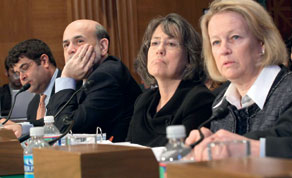
Deputy US Treasury Secretary Neal Wolin, Bernanke, Federal Deposit Insurance Corp chairperson Sheila Bair and Securities and Exchange Commission chairperson Mary Schapiro testify in the Senate in Washington yesterday
With the cap expected to be hit on Monday and the government still needing to borrow to finance its huge fiscal deficit, Bernanke told a Senate panel that “using the debt limit as a bargaining chip is quite risky.”
“It is a risky approach not to raise the debt limit in a reasonable time,” the top central banker said.
“At minimum the cost will be an increase in interest rates that will actually worsen our deficit,” he said.
“The worst outcome would be one in which the financial system was again destabilised ... which of course would have extremely dire consequences for the US economy.”
Republicans in Congress have refused to raise the debt limit, which now stands at $14.29tn, unless they can get the White House and its Democratic supporters to agree to sweeping long-term spending cuts.
The administration of President Barack Obama has said it could agree cuts but they are also demanding some tax hikes to increase revenues.
On Friday the powerful Republican leader of the House of Representatives, John Boehner, drew a line in the sand over the issue, saying that “without significant spending cuts and reforms to reduce our debt, there will be no debt limit increase.”
“And with the exception of tax hikes – which will destroy jobs – everything is on the table,” he said.
“And the cuts should be greater than the accompanying increase in the debt limit authority the president is given. We’re not just talking about billions here. We should be talking about trillions,” said Boehner.
The limit will be hit next Monday, after this week’s Treasury Department auction of $56 billion in new debt is settled, according to a Dow Jones Newswires report.
But earlier this month, Treasury Secretary Timothy Geithner said that because government receipts were running higher than projected, and by cutting certain debt issues, the government could buy several weeks, to about August 2, before it would absolutely have to raise money over the current cap or risk defaulting on its debt.
Meanwhile, a Reuters poll showed yesterday prospects for the US economy this year have dimmed slightly over the past month, leaving the central bank plenty of room before having to consider tightening policy.
After a slower start to the year than had been anticipated, economists have revised up expectations for the second quarter but trimmed their growth outlook for the final months of the year, according to the poll taken over the past week.
A surge in commodity prices in recent months has tested the Federal Reserve’s resolve to maintain its ultra-accommodative stance until the economic recovery is in full swing.
Indeed, one of the biggest risks is the potential for commodity prices to rise even higher, which could cut into spending plans for businesses and consumers, said economists, who as a group revised up their inflation forecasts by at least 0.3 percentage points for all quarters until April 2012.
“The second half of the year should be stronger, assuming oil prices don’t go much higher than where they are today,” said Kurt Karl, chief US economist at Swiss Re in New York.
The second-quarter gross domestic product consensus forecast was raised to an annualised 3.3% from 3.2%. That is up sharply from the 1.8% rate reported for the first quarter, which could be revised higher.
Consensus forecasts for Q3 held steady at 3.3%, but Q4 was trimmed to 3.4% from 3.5% and the full-year average to 2.7% from 2.9%.
Economists are now considerably more pessimistic about growth after data released last month showed first quarter GDP expanded at a 1.8% annualised rate, below economists’ expectations for 2% growth.
A like-for-like comparison between May and April polls shows 53 of 63 common contributors downgraded their growth outlook for 2011, while nine left their forecast unchanged and one upgraded.