


Reuters/Washington
Eurozone top officials have played down market speculation of a Greek debt restructuring, but a German official said Berlin would back a voluntary restructuring.

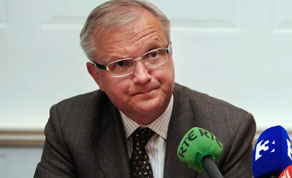
Rehn: “We take the Greeks by their word
“I have to say that all these rumours and speculation concerning a restructuring of Greek debt are totally unfounded. This not even an option,” the chairman of the eurozone finance ministers, Jean-Claude Juncker, told reporters late Friday.
Markets were spooked on earlier this week after German Finance Minister Wolfgang Schaeuble told German daily Die Welt in an interview that “additional steps” would be needed if Greece’s debt was found to be unsustainable.
The euro weakened and Greek, Irish and Spanish bond yields spiked on the comments.
On Friday, Schaeuble told reporters on the sidelines of an International Monetary Fund meeting in Washington that media had “somewhat erroneously” interpreted his comments.
“What was made out of that in the Anglo-Saxon media was somewhat misleading,” he said.
German government officials also insisted Schaeuble had not implied a debt restructuring may be necessary, nor had he strayed from the coalition’s stance that strictly opposes any mandatory or even voluntary deal with creditors to reduce its liabilities.
However, many economists argue a deal is both inevitable and desirable.
German officials said the “additional steps” mentioned by Schaeuble could also refer to additional savings measures or sell offs of state assets and Greece gave a broad outline of further moves on these issues on Friday.
Another German official on Friday made comments that lent support to the outlook for a possible restructuring. Deputy Foreign Minister Werner Hoyer, a member of Germany’s junior coalition party Free Democrats (FDP) was quoted on Friday as saying that a restructuring “would not be disaster”.
The European Union’s Economic and Monetary Affairs Commissioner Olli Rehn said on Friday that a Greek debt restructuring was not in the cards because it would not help solve Greece’s economic problems and it would hurt the eurozone.
He said the EU and the IMF would analyse if Greece’s debt, seen at 150% of gross domestic product this year, was sustainable and what the country would have need to do to make it so.
Asked what will happen if Greece’s debt fails to measure up under the sustainability analysis, Rehn said: “Let’s not jump the gun. It is premature to draw conclusions before the profound work has been done.”
He stressed Greece has to quickly start a privatisation programme the government laid out on Friday to cut its debt mountain.
“We take the Greeks by their word that they intend to privatise €15bn in the first two years and €50bn altogether by 2015, which represents 22% of GDP of Greece – in fact around 1/6th of the current debt burden.”
“So alone, it will not solve the problem of Greece, but it is a very significant part of the solution,” Rehn said.
Berlin believes Greece has already been given more breathing room thanks to last month’s EU summit deal that substantially reduced interest rate costs on bilateral loans, stretched a redemption schedule and included a Greek pledge to raise €50bn from the privatisation of state assets.
But Germany’s Hoyer on Friday said if Greece’s creditors agreed that talks with Athens “would be helpful toward a restructuring of the debt, then of course this would be supported by us,” news agency Bloomberg quoted Hoyer as saying.
Said Rehn: “This is that kind of moment when we have to ... practice rigorous verbal discipline – it is a pre-condition for overcoming the latest stage of the crisis.”
But Klaus Regling, the head of the European Financial Stability Facility, the eurozone bailout fund, said in comments released on Friday that he saw no need for a quick restructuring of Greece’s debt.
“Markets are convinced Greece will not be able to handle its debt at some point,” he told the Frankfurter Allgemeine Zeitung newspaper. “But we know that markets can be wrong and are very volatile,” he added.
The German finance ministry meanwhile denied it was drawing up contingency plans for a Greek debt restructuring after the Financial Times reported the ministry was studying various options if Athens fails to meet its fiscal targets.
“There have been media reports today regarding German plans for Greek sovereign debt restructuring. These plans have no basis in reality,” said Martin Kotthaus, spokesman for Finance Minister Wolfgang Schaeuble, in a written statement sent yesterday.