Reuters/Dubai
Egyptian share prices will soon rebound, with fear the primary cause of Cairo’s sell-off rather than a marked change in the country’s economy, although some listings will underperform due to their links to the old regime, say market analysts.

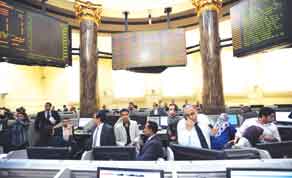
A general view of the trading room of the Egyptian stock market in Cairo. Egypt’s benchmark EGX 30 index fell by around 8.9% yesterday, on the bourse’s first day of trading since January 27, despite an upwards rally by local investors in the latter half of the session. A 30-minute suspension on all trading was enforced after the EGX 30 tumbled by almost 10% minutes after trading began
Cairo’s stock exchange reopened on Wednesday following an eight-week suspension, the first day’s trading since popular protests ended former president Hosni Mubarak’s 30-year rule.
This unrest ravaged the country’s tourist industry and briefly paralysed many businesses, including banks, leaving the Arab world’s most populous nation on the brink of recession, but with some stocks down more than 30% this year, this contraction should already be priced in.
“In the short-term, Egypt is getting back to normal pretty quickly and the market will feed off that,” said Akram Annous, MENA strategist at Al Mal Capital in Dubai.
“Markets only really plunge when there’s a bank or economic crisis usually tied to some sort of over-investment or excessive leverage cycle and we’re not seeing any of those things in Egypt. It has been nothing more than headlines and fear driving the market lower and so the trend can reverse pretty quickly.”
Cairo’s benchmark index fell 8.9% to 5,143 points yesterday, taking its 2011 declines to 28%, with 23 out of 30 stocks plunging more than 9%.
“I wouldn’t be selling Egypt now,” said Al Mal’s Annous. “I think the buyers will wait one or maybe two more sessions. I might not be saying buy Egypt stocks long-term, but I would be willing to get long here for a short-term trade.”
Local traders expect Cairo’s index to extend losses today, before finding support at 4,800 to 5,000 points.
Trading in some stocks is suspended until their ownership and financial positions are clarified. These include Ezz Steel and National Societe Generale Bank (NSGB).
Ezz Steel’s chairman, Ahmed Ezz, who was a top official in Mubarak’s party, has been detained since February17.
Orascom Telecom (OT) was the only stock on Cairo’s top index to advance on Wednesday, rising 5%. Russian operator Vimplecom is due to pay $6bn for control of Orascom and Italy’s Wind.
Analysts said the deal would boost OT’s financial position amid a dispute with Algeria over its Djezzy unit.
“Things are getting better for OT, which was previously underperforming the market,” said Mohamed Kotb, director of asset management at Naeem Brokerage.
Other Egyptian telecoms shares are seen outperforming.
“Telecom is a defensive sector with predictable cash flows that won’t be impacted in the near-term by any change in government,” added Al Mal’s Annous.
Maridive and Oil Services is also tipped to prosper, with 90% of its operations outside Egypt.
Meanwhile, volumes in Gulf Arab share markets fell yesterday, with investors eyeing Egypt’s opening, but regional bourses were otherwise little affected by Cairo’s drop.
Instead, some traders are betting new state spending plans in the region will translate into improved corporate profits.
“Government spending has increased because of the troubles, whether it’s on infrastructure, real estate or benefits,” said Mohamed Yasin, CAPM Investment chief investment officer.
“The extra surpluses generated through higher oil prices this year will more than cover these extra expenses. Liquidity for SMEs (small to medium enterprises) will increase and that will trickle down to the stock market in the next few months.”
Last Friday, Saudi Arabia announced a further $93bn in social spending. Measures to raise unemployment benefits, add jobs and raise the minimum wage were accompanied by the creation of 60,000 security jobs and more money for the religious police.
Yet some fund managers remain sceptical.
“The political issues won’t go away, so upside in the medium term is probably limited,” said Robert McKinnon, ASAS Capital’s chief investment officer. “Some will even question the government’s intent to actually spend the full amount. I think it will be watered down over time.
“Much of the stimulus is going to the people that are happy and have jobs, or own companies and land. I don’t see any intent at actual reform. So it seems to me this is a PR stunt.”