


 |
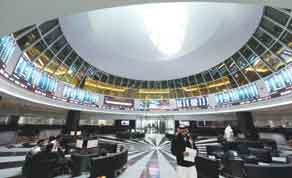
| Financial traders seen inside Bahrain’s stock exchange in Manama. The bourse suspended trading yesterday after the country declared a state of emergency and Saudi Arabian-led GCC forces arrived in the island-kingdom to restore security following deadly riots. Bahrain’s benchmark BB All Share Index has lost 1.3% this year. Credit default swaps surged 44 basis points to 359.37 on Tuesday and Fitch Ratings lowered the Gulf island’s credit ratings. |
Saudi Arabia’s benchmark rose 1% to 6,070 points.
Dubai’s measure rose 0.5% to 1,455 points. Abu Dhabi’s benchmark fell 0.6% to 2,600 points.
Oman’s index fell 0.7% to 6,247 points. Kuwait’s benchmark dropped 1.2% to 6,251 points.
“These are very much top-down markets that are retail dominated and so when we have major events, sentiment takes prevalence,” says Haissam Arabi, chief executive and fund manager at Gulfmena Alternative Investments.
“The trend is still bearish. Uncertainty is still great and so any rebound will probably be short-lived and would be more of a chance to sell.”
Bahraini forces backed by helicopters launched a crackdown on protesters yesterday, clearing hundreds from a camp.
Bahrain’s bourse was closed yesterday and an exchange official told Reuters no date had been set on when it would resume trade.
Qatar’s index fell for a third session as losers outnumbered gainers 17 to three.
Global foreign investors remain focused on fundamentals, but with risk premiums rising along with political unrest in the region, they are shifting portfolios to more stable markets, said Robert Pramberger, acting head of asset management at Doha’s The First Investor.
Saudi Arabia’s index rose 1%, recouping some of its losses from a two-day, 4.7% decline as first-quarter results season nears. Higher oil prices will boost petrochemical producers’ margins.
“A lot of companies will benefit from [oil prices] and banks are at the end of provisioning cycle so earnings will be much better,” said a Riyadh-based fund manager on condition of anonymity.
UAE’s markets were mixed, with Dubai taking support from Asian markets as Japan’s Nikkei index recovered some of its losses from Tuesday’s fall, its largest since 1987.
“International sentiment is better, with Asian markets up and that has spilled over into the UAE,” said Tarik Lotfy, Arqaam Capital Head of MENA equities.
“People like these levels and are happy buying many names in the UAE and Qatar - once there’s clarity on the regional political situation, markets should re-rate aggressively.”
Arabtec climbed 2.2% and Emaar Properties rose 1.5%.
Kuwait’s Zain dropped 7% as trading resumed following a two-day suspension after it accepted a joint bid for its quarter-stake in unit Zain Saudi.
Other Kuwait bluechips also slid, with the index dropping to within 120 points of a six-year low hit on March 7.
“The market these days is volatile, especially because of the situation in Bahrain. Everything is escalating now,” said a Kuwait-based trader who asked not to be identified.
Oman’s index fell to a two-week low. Telecoms operator Nawras, once a top Oman pick for international funds, dropped 1.5% and National Bank of Oman lost 1.3%.
“There’s likely to be sustained weakness so long as there are still geopolitical uncertainties,” said Joice Mathew, United Securities head of research, adding foreign investors continue to cut exposure to Gulf Arab markets.