Reuters/Tokyo
Japan’s central bank doubled its asset buying scheme to ¥10tn ($122.2bn) and supplied record funds to banks yesterday to shore up confidence in the economy hit by a triple blow of a massive quake, a tsunami and a nuclear emergency.

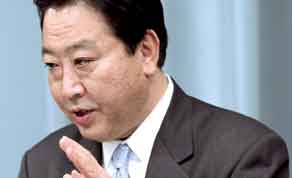
Noda says the government will do its part
The Bank of Japan said its action was a pre-emptive step after markets swooned at the shock of Friday’s 8.9 magnitude earthquake and a tsunami that may have killed more than 10,000 and has left millions without power, water or homes.
The central bank said it was still sticking to its view that the world’s third largest economy would resume its moderate recovery, though it warned about a likely drop in economic output and vowed to do whatever necessary to limit the economic fallout.
“This time’s earthquake has inflicted damage in a wide area. Output is likely to fall for some time. We are also worried that corporate and household sentiment will worsen,” the BoJ said in a statement after its board voted 8-to-1 to expand its ¥5tn fund pool put in place last October to support Japan’s recovery after the global economic crisis.
As of March 10, less than half of that initial ¥5tn pool had been used to buy assets.
In an unanimous vote the board yesterday also kept, as expected, its benchmark rate at 0-0.1%.
While the fund increase came as a surprise to some economists, some others said the central bank could have done more.
“My initial impression is that the BoJ could have done more. Its traditionally reserved stance on policy easing remains in place even after the massive earthquake,” said Masamichi Adachi, senior economist at JP Morgan Securities Japan.
Finance Minister Yoshihiko Noda, however, welcomed the central bank’s action and said the government would do its part, though he warned that it would be hard to prepare an extra emergency budget before the end of this fiscal year on March 31.
Noda said the extra spending would probably exceed what was needed after the 1995 Kobe quake, until now considered the world’s costliest natural disaster with total damage estimated at around $100bn.
Analysts said this time the threat to the $5tn economy was compounded by a continued risk of a nuclear catastrophe as engineers battled to avert a meltdown at a quake-stricken nuclear plant 240km north of Tokyo.
BoJ Governor Masaaki Shirakawa said planned power outages would affect the economy “by no small degree,” even though there were no data yet about the economic impact of the disaster.
Shirakawa also signalled the Bank of Japan’s readiness to ease policy further next month, saying the central bank will act “appropriately” at its two meetings in April when more data will become available to assess the damage from the quake on the economy.
Standard & Poor’s said that even though it saw no immediate impact on Japan’s sovereign credit rating, the quake added to stress on its stretched finances and the economic damage would depend on how the nuclear emergency plays out.
The crisis struck at the worst possible time. The deeply unpopular government of Prime Minister Naoto Kan is under pressure to contain public debt that is already twice the size of the economy, which struggles to sustain a modest recovery from a deep and long recession. The prospect of Japanese companies and insurers repatriating funds from abroad and boosting an already strong yen further darkens the economic outlook.
Noda said he would keep watching markets and noted that even though there was an initial speculative spike in the yen, it has later come off.
Prior to the rate review, the BoJ offered to pump a record ¥15tn ($183bn) in the banking system, well above the usual ¥1-2tn, to assure investors that markets will function properly. Combined with funds that will be available in further dates, the BoJ offered near ¥22tn in market operations yesterday.
Bids fell short of offers, in a sign that the market overall had sufficient cash, though Shirakawa said some money market players could still suffer fund shortages.
Damage estimates also remain sketchy. Many factories have been forced to shut in the area due to power outages, while others have reported flooding or quake damage.
Tokyo’s stocks plunged more than 6% after the market reopened yesterday as investors tried to gauge the huge economic cost of Friday’s quake and tsunami.
Moody’s ratings agency said it saw no major disruption to Japan’s payment system but that the economic fallout from the disaster appeared greater than initially expected, even though it was still waiting for a full assessment of the damage.
“The economic consequences appear to be greater than we perhaps originally expected on Friday,” Tom Byrne, Moody’s senior vice president, told Reuters Insider in an interview.
The BoJ said in a statement that there were no reports so far of system glitches or funding problems at Japanese financial institutions, including those in the quake-struck region.