


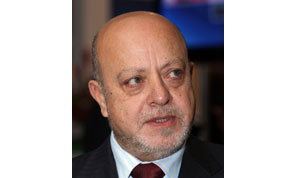
Bloomberg/
Mohamed Nedal Alchaar, secretary-general of the AAOIFI, whose standards have been adopted in countries including the UAE and
Islamic trade finance may reach as much as $800bn a year should Shariah-compliant banks strengthen co-operation with financial institutions in other countries, according to a Bahrain-based regulator.

“At this point, Islamic trade financing is very simple, it’s not focused and it isn’t competitive,” said Mohamed Nedal Alchaar, secretary-general of the Accounting & Auditing Organisation for Islamic Financial Institutions, whose standards have been adopted in countries including the UAE and
Trade among the 57-member Organisation of the Islamic Conference based in Jeddah is likely to reach $4tn in 2012, Alchaar said in an interview in
Shariah-compliant letters of credit are based on the principle of wakalah, where a bank acts as an agent and is paid fees and commissions in place of interest. Non-Islamic trade financing, which typically involves loans and the payment of interest, is forbidden under Islamic law.
Demand for services and products that comply with Shariah law is increasing by about 15% a year and assets will rise to $1.6tn by 2012, according to the
Global sales of sukuk, which pay asset returns to comply with Islam’s ban on interest rates, are showing signs of a recovery this year after slumping in 2010. Issuance has reached $3.9bn from $676mn in the same period last year, according to data compiled by Bloomberg. Offerings fell 15% to $17.1bn last year.
The yield on
“The main reason why the industry has not been able to take off is that trade finance needs parties to connect across borders,” Bobat said in a telephone interview March 3. “The industry today is still pretty local, fragmented, at best regionalized, and is in need of consolidation.” HSBC Amanah is the Islamic banking unit of HSBC Holdings in
The OIC plans to boost trade among member nations to 20% of total trading volume in 2015, according to the group’s 10-year plan posted on its website, from 14% in 2004. Trade among OIC members reached 17% in 2009, Jeddah-based Hameed Opeloyeru, assistant secretary-general of economic affairs at the OIC, said in an e-mail response to questions.
The OIC, which includes the UAE,
“Islamic banks don’t have the reach yet to go into discussion with corporates that need trade financing,” said Geert Bossuyt, the Dubai-based managing director and chief executive officer of Dar Al Istithmar, an Islamic finance advisory company established in the
Shariah-compliant banks will “become more active” over time, Bossuyt said in a telephone interview on March 3. “It’s an evolutionary issue.”
Founded in 1969, OIC members include
“I started to push for trade finance since last year,” AAOIFI’s Alchaar said. “I have been getting hundreds of questions on how it could be done and the tool we’d recommend.” Murabahah, which Alchaar said is often used for trade financing, is a transaction involving the sale and purchase of goods in which payment is deferred.
Other Islamic principles used for letters of credit include salam, kafalah and istisna and “compliment traditional trade finance letters of credits, and guarantees are fee-based and permissible,” Bobat said. A kafalah contract is used to facilitate international trade, data compiled by Bloomberg show.
Shariah-compliant bonds returned 0.1% so far this month after gaining 12.8% in 2010, according to the HSBC/Nasdaq Dubai US Dollar Sukuk Index. Debt in developing markets gained 0.4% in March and climbed 12.2% last year, JPMorgan Chase & Co’s EMBI Global Diversified Index shows.
The difference between the average yield for sukuk and the
The Bloomberg-AIBIM-Bursa Malaysia Sovereign Shariah Index, which tracks nine of the government’s most-traded ringgit- denominated securities, gained less than 0.1% to 101.585 on March 4. The gauge has gained 0.5% so far this year.
The AAOIFI, which has more than 200 members, sets accounting and auditing standards that are used in Bahrain, the Dubai International Financial Centre, Jordan and Lebanon, according to its website.