AFP/Tokyo
Japan and India signed a free trade pact yesterday under which the high-tech nation and the South Asian giant will scrap tariffs on 94% of goods within a decade.

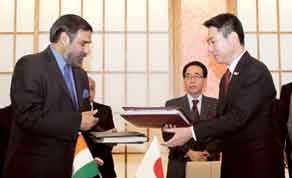
India’s Sharma and Japan’s Maehara exchange documents after signing the Comprehensive Economic Partnership Agreement in Tokyo, yesterday
Japan’s Foreign Minister Seiji Maehara and Indian Commerce Minister Anand Sharma signed the deal in Tokyo, hoping it will boost trade between the two countries.
“We have no doubt in our minds that this will usher in a new era of economic engagement, which will bring development, innovation and also prosperity in both societies,” Sharma said.
Japan is seeking more such partnerships as it looks to catch up with export rival South Korea, and after China overtook it as the world’s second-largest economy in 2010.
In October India’s Prime Minister Manmohan Singh met his counterpart Naoto Kan and stressed the warm ties linking two of Asia’s biggest democracies at a time of high diplomatic tensions between Japan and communist-ruled China.
The deal with India may also bring further co-operation over rare earth materials used in hi-tech products as Japan looks to diversify supply after the spat with Beijing led to shipment disruptions last year.
Resource development “definitely figured in our discussions,” Sharma said yesterday.
Trade between the two countries totalled ¥300bn ($10.7bn) in 2009 – less than 1% of Japan’s total foreign trade.
The agreement, approved in principle by both countries’ leaders last year, aims to open new markets for Japan as its population ages and shrinks, and to fuel the rapid growth of emerging power India.
It will help Japanese auto makers such as Suzuki by lifting tariffs on car parts shipped to its factories in India, and ease access for Indian generic drug makers to a lucrative market in fast-greying Japan.
India – which has already signed a free-trade deal with South Korea, Japan’s export rival in autos and electronics, but not with China – will become Japan’s 12th free trade partner.
The agreement, for which Tokyo hopes to gain legislative approval by the summer, will immediately reduce to zero Japanese tariffs on almost all industrial products imported from India.
Tokyo also plans to scrap duties on some foodstuffs – including curry ingredients, pepper and tea – within 10 years, but will maintain a high tariff wall to protect its politically sensitive rice sector.
India will gradually cut trade barriers on auto parts, as well as on Japanese steel, electronics and machinery products, to zero.
But the South Asian giant, where auto sales to the growing middle class are booming, will maintain tariffs on assembled vehicles.
India will also ease access for Japanese single-brand companies, allowing them controlling stakes of 51% in local entities, and giving them the right to set up franchises in India.
But in other sectors, the two countries only agreed to continue talks.
Japan, which tightly controls immigration, has so far failed to grant India’s wish to send nurses and caregivers to Japan, where almost one in four people is aged over 65 and the aged-care sector is suffering labour shortages.
The Indian minister expressed hope that his country would eventually be able to export its welfare workers to Japan, stressing: “We have a lot of good caregivers and nurses who, when invited, will make a good contribution.”
Under separate free trade agreements Japan currently allows Indonesian and Philippine nurses and caregivers to work there.
Another key deal on civilian nuclear power cooperation, sought by New Delhi as it looks to power its expanding economy, currently remains beyond reach.
Japan and India launched negotiations in June on a pact that would allow Tokyo to export its cutting-edge nuclear technology to the energy-hungry South Asian nation, a hotly contested market for atomic plants.
But Japan – the only country to have suffered atomic bombings, and a key voice in global de-nuclearisation efforts – is concerned because nuclear-armed India has not signed the Nuclear Non-Proliferation Treaty.