


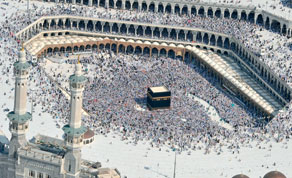
Every year, millions of Muslims make the journey of their lifetime. They come from all over the world for the sole purpose of fulfilling one of Allah’s greatest commandments to mankind – the Haj.

Abu Hurairah, may Allah be pleased with him, narrated that “The Prophet sallallaahu ‘alaihi wa sallam ( may Allah exalt his mention ) was asked, ‘Which is the best deed?’ He sallallaahu ‘alaihi wa sallam said: ‘To believe in Allah and His Messenger.’ He was then asked, ‘Which is the next (good deed)?’ He said: ‘To participate in Jihad in Allah’s cause.’ He was then asked, ‘Which is the next?’ He sallallaahu ‘alaihi wa sallam said: ‘To perform an accepted Haj.” [Al-Bukhari]
For over 1,400 years, believers have been making Haj to the House of Allah in Makkah. It is an obligation for each and every Muslim to perform Haj at least once in his/her lifetime if he is physically and financially able.
Pre-Haj preparations
Due to the importance of Haj, preparations for it should not be taken lightly. Besides planning the actually logistics of the trip, the Muslim needs to prepare Islamically, physically, mentally, and financially for this great act of worship.
Islamically, one of the most important preparations for this journey is acquiring the necessary knowledge for performing the rituals of Haj and ‘Umrah correctly and in accordance to the Sunnah of the Prophet sallallaahu ‘alaihi wa sallam.
This means studying and learning about Islam, acquiring a high degree of Eemaan (faith) in order to deal with the emotional and physical demands of Haj, and learning correctly the actual religious rituals and requirements from the beginning to the end of Haj and ‘Umrah.
Studying and learning about the Haj can be accomplished in a variety of fashions, from reading books on the subject or using computer programmes which utilise a multimedia format, to actually taking classes offered by Islamic centers on the rituals of Haj and ‘Umrah. Furthermore, many travel groups that specialise in Haj and ‘Umrah trips offer Haj preparation classes as well as scholars and students of knowledge that help those going for Haj perform the rituals of Haj and ‘Umrah correctly.
In addition, it is important to mention that spiritually preparing for Haj and ‘Umrah is also a lesson on how to follow the footsteps of the Prophet sallallaahu ‘alaihi wa sallam who taught the Companions may Allah be pleased with them – a lesson that can be transformed into other acts of worship. Preparing for Haj is a spiritual experience with a period of self-reflection and a lesson in piety and humility.
The pilgrim must focus on his sole intention of performing Haj. That it is solely for the pleasure of Allah and in accordance to His Commandment regarding this act of worship. The believer also needs to resolve any conflicts or differences between him and others and seek forgiveness for any acts of transgression. This stage of preparation should take place long before the actual departure for Haj.
Other preparations that should be planned long before the actual trip are financial in nature. Simply, going to Haj costs money. Furthermore the pilgrim must pay off any old debts (this includes any type of loans), household bills, and leave enough money to pay any living expenses likely that other members of his family not making Haj might need. Finally it is important to complete one’s will (wasiyyah) before departing on Haj.
Another important step in preparing for Haj is the need to prepare physically for the event. Not only is Haj a spiritual event, it also requires a lot of physical stamina from the participant. Haj is not a picnic! Completing the rites of Haj includes a lot of walking, mixing with many people, living in high temperatures (during summer), and exerting a great deal of effort. Another important step in preparing physically for Haj is to make sure you are medically fit for the trip. Individuals with chronic health issues need to see their primary care physician in order to discuss any medical risks that need to be addressed prior to their Haj experience.
Another recommendation is that these individuals also travel with a healthy caretaker in case any problems might arise during the actual Haj. In addition, pilgrims must have the necessary vaccinations required by the Saudi Government. Because of these issues, it is also important to emphasise that one should complete Haj and ‘Umrah as soon as one is able to both physically and financially. Some people wait until they are old to go for Haj.
This is wrong and makes Haj more difficult than necessary for the participant and in many cases for his traveling companions. Performing Haj as soon as possible corresponds to the Hadeeth narrated by Abdullaah Ibn Abbaas, may Allah be pleased with him, who said: “The Prophet sallallaahu ‘alaihi wa sallam said: ‘He who intended to perform Haj should hasten to do so.’” [Abu Daawood]
The last pre-logistic preparation centers on preparing mentally for Haj. This includes learning and accepting that the Haj experience includes frustration, intense desert heat (during summer), and various differences in culture and food. The pilgrim can expect to stand in long lines, be shoved and pushed by others while completing the necessary rituals, and be in an uncomfortable close proximity to members of the opposite sex.
One purpose of Haj is for the individual to be tested. The individual will be tested on physical, emotional, and spiritual levels.
Logistic decisions
After preparing oneself internally and financially for one of the most important events in the life of a Muslim, the pilgrim must plan and make actual logistic decisions regarding his/her journey. While one can always make the trip by himself or with a small group of individuals close to him, in this modern day this is not always the best choice. It is not uncommon for hotels to be fully booked for at least one year in advance.
Furthermore, unless one starts searching very early, it is also hard to find airline reservations and available flights to Saudi Arabia during the Haj season and during Ramadan for ‘Umrah. Because of these challenges in planning, many individuals opt to join a travel group that specialises in Haj and ‘Umrah tours. Since not all tour groups are equal and provide the same quality service, there are a number of items to look for in choosing the right tour group.
The first thing to look for in a group is the price of the trip. Most groups offer a variety of price packages that depend on a variety of factors. These factors include the type of hotel, number of people per room, use of private transportation, and whether or not food is included within the package. Haj is not the time to go cheap. Since some Muslims are generally accustomed to a certain degree of comfort, they would find less expensive accommodations unacceptable and uncomfortable.
For example, during Haj some hotels accommodate up to 15 people per room sharing a single communal bathroom. Furthermore, many people are used to a certain degree of cleanness in their hotel rooms and eating establishments that is not found in all hotels and restaurants. Another factor to consider is the distance of the hotel accommodations from the Haram (the Sacred Area). As a rule of thumb, if the price is too cheap, so is probably the quality of the package. In other words, the cheaper in price of the package, the higher the probability of encountering problems during your Haj, which in turn, can make for a more difficult Haj experience.
Another thing to look for is the number of years of experience of the tour operator. Generally, experienced operators are the best since they are able to handle any problems that can and will probably occur during Haj or ‘Umrah. Also it is important to make sure that an experienced leader from the tour group accompanies the group for Haj, since it is not uncommon to loose members of your group sometimes for hours or even days.
Other problems that often occur include lost or stolen belongings and money, illnesses that require medical attention, and the death of a group member. It is important for the pilgrim to understand that their Haj will not be problem free. Problems arise frequently and an experienced tour operator is needed to handle the situation. When looking for a tour operator, it is important to ask how they handle problems. If the potential tour operator tells you that you will have a problem free Haj, continue searching for a better program.
Researching the business strength of your potential tour group is another important step in choosing a tour group. Generally, it is better to choose groups that have offices or contacts within Saudi Arabia. These contacts can make a Haj experience run more smoothly in a number of areas which include helping facilitate and streamline the customs process in Jeddah (which can take between 8 to 20 hours) to providing private ground transportation and buses for the pilgrims. One thing that is highly recommended is to look for a company which offers its own private tour buses. This is especially important since the pilgrim can literally expect to wait for hours for public transportation.
Another important quality of the travel agent is the degree they are versed in the rules and regulations of the Haj process. This includes helping the pilgrims with the visa process from the Saudi Arabian embassy or consulate to understanding the Haj and ‘Umrah rites from an Islamic standpoint.
For example, in order for a pilgrim to enter Saudi Arabia, there are certain requirements that need to be met from the Saudi Arabian government. These requirements include the necessary vaccinations. Women must have proof of being accompanied by a Mahram (non-marriageable relative). In addition, there are fees that need to be paid in advance for use of the public transportation system and use of the tents in Mina along with the necessary forms that need to be completed in full and approved prior to the trip.
It is also best to use a travel agent that utilises scholars as religious guides for the trip. Besides helping to keep the travel group focused on the worship of Allah, rather than on worldly distractions such as chatting, playing cards, etc., he is also available to ensure that group members are correctly performing the rituals.
Making Haj and ‘Umrah can be one of the most important events in a Muslim’s life. However, one should not make the decision to go on Haj or ‘Umrah at the last minute. The planning of this trip takes time and is a process within itself.
Besides the financial aspects of the trip, one needs to be ready for the trip from an Islamic standpoint. This includes studying Islam, knowing what is obligatory and what is non-obligatory in the rites of ‘Umrah and Haj, and the development of a strong Eemaan (faith). While both the process and task of Haj can be difficult for some, the rewards of Haj can be underestimated.
In a Hadith narrated by Abu Hurairah, may Allah be pleased with him, the Prophet sallallaahu ‘alaihi wa sallam said: “Whoever performs Haj for Allah’s pleasure and does not have sexual relations with his wife and does not do evil or sins then he will return [after Haj free from all sins] as if he were born anew.” [Al-Bukhari]
Article source: http://www.islamweb.net/emainpage/