


By Stephanie Simon and James B Kelleher/Chicago
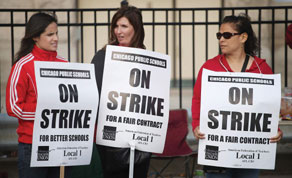
Chicago teachers walking picket lines this week, in a strike that has closed schools across the city, are taking on not just their combative mayor but a powerful education reform movement that is transforming public schools across the US.

Teachers picket outside Burr Elementary School in Chicago yesterday. More than 26,000 teachers and support staff walked off of their jobs on September 10 after the Chicago Teachers Union failed to reach an agreement with the city on compensation, benefits and job security
The new vision, championed by Chicago Mayor Rahm Emanuel and US Education Secretary Arne Duncan, who used to run Chicago’s schools, calls for a laser focus on standardised tests meant to gauge student skills in reading, writing and maths. Teachers who fail to raise student scores may be fired. Schools that fail to boost scores may be shut down.
And the monopoly that the public sector once held on public schools will be broken with a proliferation of charter schools, which are publicly funded but privately run - and typically non-union.
To reformers, both Democrats and Republicans, these changes offer the best hope for improving dismal urban schools. Many teachers, however, see the new policies as a brazen attempt to shift public resources into private hands, to break the power of teachers unions, and to reduce the teaching profession to test preparation.
In Chicago, last-minute contract talks broke down not over pay, but over the reform agenda, both sides said on Sunday. The union would not agree to Emanuel’s proposal that teacher evaluations be based in large measure on student test scores.
Nor would the union accept his push to give principals more autonomy over hiring, weakening the seniority system that has long protected veteran teachers. Already, the demographics of the teaching profession in Chicago have notably shifted, as the private managers who run charter schools tend to favor rookie teachers who are younger and far less likely to be minorities, studies have shown.
Today, just 19% of the teaching force in Chicago is African American, down from 45% in 1995, the union says; organisers fear that shift means fewer teachers have deep roots in and passion for the communities where they work.
About 42% of the city’s 400,000 public school students are black and 87% are low-income, according to district figures.
“This is fight for the soul of public education,” said Brandon Johnson, an organiser with the Chicago Teachers Union.
Opponents reject such high-flying rhetoric as self-serving; they describe the union as an obstructionist force that stands in the way of progress for kids.
“This is a union very much concerned with job protection and job security,” said Rebecca Nieves Huffman, who runs the local branch of Democrats for Education Reform, a coalition of wealthy financiers and entrepreneurs pushing to remake public schools.
“It’s crazy to think if we keep doing the same model of school over and over, we’ll get different results,” said Juan Jose Gonzalez, the local director of Stand for Children, another reform group allied with the mayor. “Teachers need to decide if they’re going to be part of this process or not.”
Teachers in Chicago - at least, a core group of them - long ago chose confrontation over co-operation.
That group spent two years quietly building support among teachers for their vision of a more aggressive union that would fight reform on principle as well as seeking to protect members’ pay and benefits.
In June of 2010, the activist faction’s candidate for union president, Karen Lewis, won the job. Her ascent symbolised the union’s transformation to a “big, red fighting machine,” said Debby Pope, a union official.
Pope discussed that strategy at the American Federation of Teachers’ convention in Detroit earlier this summer. While the AFT carried on official business in the convention center, Pope held court for a handful of teachers and union organisers from across the US in the back room of the Anchor bar.
She urged them to use aggressive tactics to resist a reform agenda that pins much of the blame for poor student achievement on bad teachers. In Chicago and elsewhere, teachers respond that the main problem is poverty; they say their students do poorly because they’re hungry, because their lives are chaotic, because they don’t have the eyeglasses they need or quiet places to do their homework.
“We say no, teachers are not the root of the problem,” Pope told the group gathered in the bar. “The root of the problem is the way capitalism is destroying public schools.”
Teachers have raised similar concerns elsewhere, but with limited success.
In the past three years, at least 20 state legislatures have passed bills setting up new teacher evaluation systems; many require student test scores to be the primary factor. (Teachers are typically rated not on how many students pass the test, but on how much growth students show from one year to the next.)
In some cities, teachers have worked with politicians and administrators to design evaluation systems they feel are fair. AFT President Randi Weingarten has praised that approach, which she calls “solution-driven unionism.”
In Chicago, though, negotiations went nowhere.
“Nowhere else has a teachers union said, ‘Enough is enough,’ “ said Mark Naison, a professor of African-American history at Fordham University and a union supporter. “This is ground zero of resistance to corporate education reform.”
The union stand comes in a city that’s long been at the forefront of education reform.
In the late 1980s, US Secretary of Education William Bennett condemned Chicago’s public schools as the worst in the nation.
Ever since, civic leaders have been trying to fix them.
The first wave of reforms called for empowering citizens by creating hundreds of locally elected school councils across the city. That lasted just a few years, until the state stepped in to centralize control over Chicago schools in the hands of the mayor, who was to appoint a chief executive officer to run the district more like a business.
The first CEO, Paul Vallas, ushered in high-stakes testing: Thousands of students a year were held back a grade or denied entry into high school because they couldn’t pass standardised tests.
Vallas’ successor, Arne Duncan, took high-stakes testing a step further. Duncan closed scores of schools with poor test results. He remade others by firing the staff and hiring private turnaround specialists to run the schools. Duncan also encouraged the spread of charter schools.
Results have been mixed.
High-school graduation rates have improved and high-school test scores are up, according to an analysis last year by the Consortium on Chicago School Research at the University of Chicago. But test scores have barely budged at the elementary and middle grades.
And two decades of reform have done nothing to close the racial gaps in achievement levels. On the contrary, black students have fallen farther behind than ever, the consortium found.
Chicago also fares poorly compared to other cities. On the most recent national exam, Chicago fourth-graders didn’t come close to the average scores posted by students in other large urban districts, in either reading or math.
There are some bright spots. Some elementary schools taken over by private turnaround specialists - and bolstered withmns in additional public and private funds - have boosted test scores significantly.
Some charter high schools, too, have dramatically raised scores and college matriculation rates among their low-income students, who must commit to spend hundreds more hours in the classroom than their peers and follow a rigid code of behavior.
“Parents have voted with their feet,” said Michael Milkie, the CEO of the Noble network of charter high schools, which has thousands of families on its waiting list. If city leaders push ahead with plans to expand the charter network, including eight new Noble campuses over the next four years, “Chicago can serve as a model for the nation,” Milkie said.
Yet teachers, backed by some civic activists, contend that while some charters stocked with highly motivated students have flourished, Chicago’s reform policies have hurt public education overall.
They complain that regular neighbourhood schools suffer with crumbling facilities and overcrowded classrooms while privately run charters and turnaround schools get pricey renovations, new equipment and additional staff.
And they argue that closing schools has destabilised poor neighbourhoods and even sparked violence, as rival gangs end up crammed together into the schools that remain. - Reuters