


By Anna Tomforde/London
More troops drafted in, long queues at airports and cracks in a key motorway link - two weeks before the Olympic Games security planning seems to be in disarray.

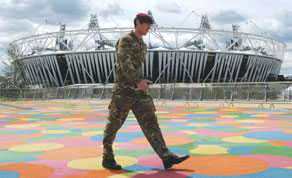
A British soldier at the Olympic Park in Stratford in London yesterday. The UK government has called upon an extra 3,500 military personnel to protect the London Olympics
The announcement yesterday that 3,500 extra military personnel would be drafted in to guarantee security at Olympic venues has left the government, organisers LOCOG and security firm G4S with red faces.
The last-minute changes coincided with reports of lengthy immigration queues at London’s Heathrow airport, and the continued closure of a flyover on a main stretch of motorway into central London following the discovery of dangerous cracks.
There had long been rumours that G4S, the private security contractor which guards anything from prisons to banks and luxury apartment blocks, would not be able to complete the security clearing of candidates on time.
“This has been an unprecedented and very complex security recruitment, training and deployment exercise which has been carried out to a tight timescale,” G4S said.
“We have encountered some delays in progressing applicants through the final stages but we are working extremely hard to process these as swiftly as possible,” it added.
The firm said it had interviewed and screened 80,000 applicants for the 10,000 jobs, but more vetting was still needed.
Unconfirmed reports put the shortfall in the numbers that will finally be provided by G4S as between 25 and 35%. The company has been paid £284mn ($438mn) out of a total budget for venue security of £553mn.
“G4S has let the country down and we have literally had to send in the troops,” Labour parliamentarian Keith Vaz said.
But he agreed with other critics that now was the time for action, and that analysis of what went wrong should come later.
“It beggars belief that these private companies can be seriously considered as providers of essential public services like policing,” trade union leader Len McCluskey said.
The government, meanwhile, was keen to play down the impact of the embarrassing last-minute change.
“Our planning with LOCOG and other security agencies allows for a variety of contingencies,” said Home Secretary Theresa May in an emergency debate in parliament.
She was confident that British forces - “the finest in the world” - word rise to the task.
“They stand ready to do their duty whatever the nation may ask,” said May. “This task is the most important facing our nation today. There is no question of Olympic security being compromised.”
As a reward, soldiers and their families would receive 10,000 tickets for the Olympics and Paralympics plus 7,000 tickets for dress rehearsals of the opening and closing ceremonies.
After the latest revision of security planning, troops will make up 17,000 of the total of 23,700 security personnel deployed at Olympic venues, complemented by private security guards and unpaid volunteers.
Soldiers would carry out general security at venue gates and bag checks, as well as fulfilling specialist roles in bomb disposal squads and logistical support.
In addition to being deployed at the more than 30 sporting venues, the uniformed men and women would also patrol 70 non-competitive venues such as car parks and hotels.
Critics said yesterday that the overwhelming presence of the military in the security arrangements could undermine the original concept of what was known as the “blue Games” - an event dominated by the navy uniforms of the police.
“The heavy military presence at the Olympic Park is likely to divide opinion,” said a sports commentator.
But James Brokenshire, state secretary in the Home Office, denied in a BBC interview that the troop deployment would “change the face of the Games.”
“There was always a blend of a private security and military component. This remains a sporting event and not a security event,” he said. “We have a fantastic military. They will ensure a fantastic event.” —DPA