By Dr Cesar Chelala/New York
Burma’s electoral commission has told opposition leader Aung San Suu Kyi to stop calling the country Burma and instead the call it Myanmar, its official name.

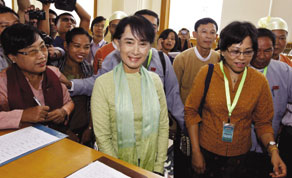
Aung San Suu Kyi smiling after registering herself in attendance record at the Pyithu Hluttaw (lower house parliament) in Naypyitaw, Myanmar, yesterday. It marked Suu Kyi’s debut in parliament as opposition leader. Disagreement on what to call the country has erupted after Suu Kyi’s recent trip to Europe, where she continuously called the nation Burma. Observers believe that authorities are trying to assert themselves after Suu Kyi, who leads the National League for Democracy party, was widely praised during her trip
In a statement published in The New Light of Myanmar, the electoral commission has chided Aung San Suu Kyi stating: “As it is prescribed in the constitution that ‘the state shall be known as The Republic of the Union of Myanmar’, no one has the right the call the country Burma.”
Aung San Suu Kyi is in her right, and should continue to do so, to express what has been worldwide condemnation of Burma’s military regime.
Disagreement on what to call the country follows Aung San Suu Kyi high-profile trip to Europe, where she continuously called the country Burma. Observers believe that authorities are trying to assert themselves after Aung San Suu Kyi, who leads the National League for Democracy (NLD) party, was widely praised during her trip.
While the electoral commission informed the NLD “to address the name of the state as prescribed in the constitution…and respect the constitution,” Nyan Win, NLD spokesman responded by stating that calling the country Burma “does not amount to disrespecting the constitution”.
There is a long history behind this disagreement. In 1989, the then ruling military junta decreed that the country should change its name from the “Union of Burma” to the “Union of Myanmar”. The move, apparently, was intended to appease minority non-Burman ethnic groups.
Later, the name was modified to the “Republic of the Union of Myanmar”. However, those opposing the military, including Aung San Suu Kyi, ignored the modification and continued to call the country Burma, to the evident irritation of the military.
Derek Tonkin, chairman of Network Myanmar, disagrees with the use of the word Burma and states, “Daw Aung San Suu Kyi no doubt carries a passport stamped ‘Republic of the Union of Myanmar’ and describing her as a ‘Myanmar’ citizen. But if she wants to use ‘Burma’ when she speaks English, and ‘Myanmar’ when she speaks Burmese, then that’s fine by me”.
Anthropologist Gustaaf Houtman, an expert on Burma’s politics, wrote, “There is a formal term which is Myanmar and the informal, everyday term which is Burma. Myanmar is the literary form, which is ceremonial and official and reeks of government.” Local opposition groups prefer to use the ‘old’ colloquial name, at least until Burma has a legitimate government.
Undaunted by her country’s government criticism, Aung San Suu Kyi has continued using the name Burma during her visit to Britain and Norway. Several Western countries, including Britain and the US, continue to call the country Burma in unofficial statements of support for the democracy movement in the country.
However, as the daughter of Aung San, considered the father of modern-day Burma and a tireless fighter for democracy and human rights in her country, nobody has greater moral authority than Aung San Suu Kyi to call the country by its former name.
Responding to the Burmese government criticism of her using the word Burma Aung San Suu Kyi said that she can call her government the way she likes and added, “I used the name freely in keeping with democratic principles”. She also said in Rangoon that General Saw Maung had failed to consult the Burmese people when he decided to change the country’s name from Burma to Myanmar in 1991.
There is a strong emotional and moral connotation to the name Burma. It should continue to be called so until effective democracy returns to the country and a mechanism is chosen to make a decision on what to call the country. If this enrages the military, it will still be a small price they have to pay for the brutality that for decades they have unleashed on the country.
l Dr Cesar Chelala is a winner of an Overseas Press Club of America award.