By Abdullah Omar/Amman
From music and art festivals to stunning landscapes and ancient ruins, Jordanian officials say the kingdom is ready to welcome large numbers of visitors from Gulf states and Europe this summer.

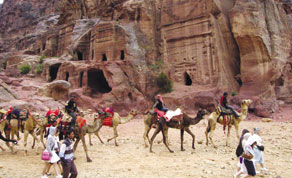
Tourists are wooed for a camel ride in Petra. Jordan tourism is benefiting from the growing instability in Egypt and Lebanon
Like most of the Middle East, the kingdom has seen growing popular pressure for reform. But unlike Egypt and Syria, Jordan has been remarkably stable and tourists are coming back.
Jordanian Minister of Tourism and Antiquities Nayef al-Fayes said tourism was down by 16.5% in 2011 and added that the country’s tourism sector lost $1bn when most bookings by European tour operators were cancelled.
But this summer, as tourists from Saudi Arabia, Kuwait, Dubai and Abu Dhabi are planning their vacation, Jordan is again an attractive destination, and major cities are expecting unprecedented traffic congestion.
During the month of May, tourism revenues grew by nearly 40% as the number of GCC visitors increased, with some of them heading to beat the heat in Jordan, which is often cooler than the Gulf.
Financial experts from the currency exchange industry have also revealed a surge in demand for the Jordanian dinar, mostly from Gulf visitors. The rising demand, coupled with financial transactions of Jordanian expatriates in the Gulf, which reached nearly $1bn, have consolidated the strength of the dinar.
Tourism industry experts say revenues will be essential to help the country deal with its severe financial difficulties, which includes foreign debt at $20bn and a fiscal budget running with a deficit of more than $2bn.
Meanwhile, the Jordan Hotel Association have reported that the hotel occupancy currently stands at an average rate of 80%, with a 100% occupancy rate expected soon. Tourism is one of the most important components of the Jordanian economy which has few natural resources to draw upon.
Tourism minister al-Fayes has also revealed the government plans to have a series of summer festivals in Amman, Jerash, Karak, Fuheis and other parts of the kingdom.
The Jerash summer festival which has begun, promises visitors and families an array of activities including concerts by famous artists, musical shows and cultural activities.
Amman will also see a variety of street festivals with artists and musicians including samba bands, fire breathing acrobats and stilt-walkers entertaining local residents and the visitors.
The government has said it has taken measures to boost tourism revenues by making it easier for foreign tourists to visit, and by imposing higher fees at key tourist sites such as Petra and Wadi Rum. A one-day entrance to Petra, for example, costs $125, although the fee will be lower if a tourist stays overnight in Jordan.
Jordan is benefiting from the growing instability in Egypt and Lebanon, two major destinations for Gulf holidaymakers. But officials from the country’s tourism board believe there is room for even more tourists.
Jordan has been banking on the unique natural wonders of Petra and the Dead Sea to lure visitors from Europe.
Abdul Razaq Arabiat, a senior official at the Jordan Tourism Board, believes changes in the region carry with them new opportunities.
“The current political, economic and social changes as well as market trends represent a major challenge for tourism, but also provide new opportunities,” he said, adding that the government has worked on promoting its continued stability during a time of uncertainty in the region. “We have invited more than 400 journalists this year to show the stable situation in Jordan.” — The Media Line