AFP/Cairo
The term “clinically dead” applied to Egypt’s Hosni Mubarak after a stroke on Tuesday night, but then swiftly changed by doctors to “coma”, is used when a person’s heart, lungs and brain have all stopped working.

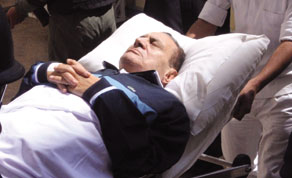
Egypt’s state news agency Mena first reported that Mubarak, 84, was declared clinically dead after suffering a stroke in prison. But a medical source later said the ousted leader was in a coma on life support in a Cairo hospital
A person in a coma, on the other hand, even on life support, may still have some brain activity, breathe on their own or have a regular heart beat.
There are different stages of coma, however - the final of which is termed “irreversible” and is just another way of saying that a person is, in fact, dead.
The legal and scientific definition of death is a topic that has not ceased to cause debate.
To add to the confusion, there exists an array of apparently synonymous terms - brain death, biological death, vegetative state...
Whereas in the past the lack of a heart beat or spontaneous breathing was enough to lead to a declaration of death, that changed with the advent of resuscitation techniques like CPR (cardiopulmonary resuscitation) and defibrillation, organ transplants, and life support machines.
A case in point is former Israeli prime minister Ariel Sharon, who slipped into a coma after suffering a massive stroke on January 4, 2006, and is still alive more than six years later.
Egypt’s state news agency Mena first reported that Mubarak, 84, was declared clinically dead after suffering a stroke in prison.
But a medical source later told AFP the ousted leader was in a coma on life support in a Cairo hospital.
Doctors use the term clinical death to signal there is no hope of resuscitation after a person has stopped breathing on their own, their heart has stopped beating and their brain shows no signs of activity (brain dead).
In many countries, this is a requirement for permission to be granted for a patients’ organs to be harvested for transplant.