


 |
|
The basic rules haven’t changed much throughout the years since the first written set of table manners in the year 1290 |
You’re having a business lunch with your most important client. You take a bite of food and ... UGH! You’re munching on a mouth full of gristle that you need to spit out. So do you reach for the napkin to secretly discard the food? Don’t you dare, says etiquette expert Sonia Jacobson.
“If it goes in with the fork, it comes out with the fork,” Jacobson said. And you put it right back on the plate.
That got quite a few cringes, squirms and giggles from the 30 people getting a business dinner etiquette lesson at The Bankers Club in Miami.
“It’s only food - what’s the big deal?” she said. “And if it goes in with the fingers, it comes out with the fingers” - like when you need to discard an olive pit.
It should be noted that these folks in attendance were no novices - the room was filled with professionals dressed to the nines: top executives, students, retirees.
The proper international way to eat - if you are right handed - is to keep your knife in your right hand and your fork in your left.
Americans usually juggle silverware between hands throughout a meal, such as cutting with the right and then picking up the fork with the same hand. It’s not necessarily bad manners, Jacobson told the crowd, but it just won’t impress a foreign client.
The basic rules haven’t changed much throughout the years since the first written set of table manners in the year 1290. But Jacobson, a corporate image consultant, says she is busier than ever teaching business manners, whether it’s a private lesson at a law firm or lecturing high school students through her non-profit agencies Suited for Success and Dress for Success Miami.
“It’s amazing how a lot of students will get out of law school and they don’t know how to eat properly,” Jacobson said. “It should be common sense.”
Etiquette consultant Colin P D’Arcy, president of ImageMentor, said he’s noticing lots of young people entering the workforce just were never taught business etiquette - perhaps because parents these days “don’t have the time”.
But it’s not just a lack of manners - it’s not always realising the habits of other cultures. Take a client from Spain out for an afternoon bite to eat, and “lunch could be three hours”, Jacobson said.
So it’s important for the guest to order first - and you order the same number of courses. But if the servings are huge, don’t feel like you have to finish every course.
Unless it was clearly stated that it is a working lunch and you know the guest, don’t discuss business until after the main course is finished. In the meantime, make small talk, such as asking the guest about their job.
One of the biggest issues for Jacobson these days is the faux pas of mobiles at the table.
“You keep that phone out of sight,” she said. And if it is an emergency, “you must excuse yourself at the table and take it outside”. But fingers, silverware and mobiles aside, the topic that got the most talk was how to handle the bill.
You can avoid an awkward situation by choosing your words carefully when inviting someone out. A host should say “Would you like to join us for dinner?” or “Be our guest” or “I’d like to invite you to lunch” to make it clear that you are treating them to a meal. If you want to split the bill, use a more casual phrase like “Let’s get together for lunch”.
Accidents happen, and there’s a proper way to handle that, too. Drop a napkin or silverware on the floor, and you better let it go. Jacobson insisted you should never reach to pick it up - that’s the job of the wait staff.
Simply get the attention of the wait staff and they should bring you a fresh item.
The bottom line is, if something awkward happens - like a guest drinking the water from a finger bowl or a big client has crumbs on their face - more often than not it’s best to not mention anything.
“The last thing you want to do is embarrass a guest at a dinner table,” Jacobson said.
Don’t make these common business etiquette mistakes!
lThe guest should get the best seat at the table, which is the seat that faces the room - not the wall.
lLet your guest order first. When it is your turn, order the same number of courses as they have.
lKeep that phone off the table. If you know you will be getting an important phone call during the meal, let your guest know before the meal starts, and excuse yourself from the table to take the call.
lOnce you start eating, your utensil should never touch the table again - that means don’t prop up a used knife or fork half on the table and half on the plate. It should rest completely on the plate.
lIf there’s a tablecloth and silverware on the table, don’t eat with your fingers. But you can use your fingers to break off a piece of bread. (But asparagus may be eaten with your fingers as long as it is not in a sauce!)
lThe only time it’s acceptable to pick up a bowl and drink your soup is if it is a clear broth soup. If there’s a noodle in it, use a spoon.
lNever cut spaghetti with a knife. You must twirl it on your fork. (It’s OK to use a spoon to help you twirl.)
lYou CAN put your elbows on the table - as long as it’s before or after a meal.
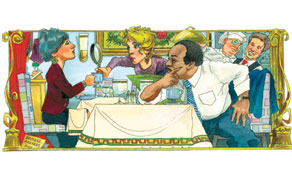
lWomen: Don’t prop your head up with your hands while eating. Men: Don’t throw your tie over your shoulder or tuck your napkin in your pants.
lIf a napkin or piece of silverware is dropped, let it go! Get the attention of the wait staff to let them know what you dropped so they can replace it. (If it is at a friend’s house, pick it up - chances are they don’t have maids to pick up after you.)
lNever pick your teeth with a toothpick (or fingernails) at the table. And ladies should never apply makeup at the table.
lIf you have to sneeze suddenly, use your napkin to cover your nose and sneeze away from the table. If you have to blow your nose, excuse yourself from the table.
lDon’t sop up the sauce on your plate with a piece of bread.
lTo signal to a waiter that you are done with your plate, place the knife and fork parallel on the plate at the 4 o’clock position.