


 |
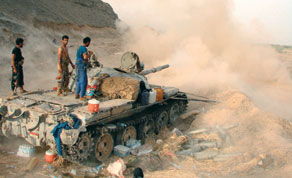
| Yemeni soldiers standing on a tank as it fires during the fight against Al Qaeda militants in the southern town of Zinjibar. According to media reports, the Yemeni army forces retook several positions from Al Qaeda militants following fierce battles in Zinjibar town. The militants occupied Zinjibar and several other towns in southern Yemen for nearly a year. The US and its allies want to help the Yemeni government stand on its own feet and avoid the country becoming a Somalia-style failed state |
US policymakers might talk down “boots on the ground” in Yemen but with an estimated several hundred military advisers already deployed, Washington and its allies are already being drawn ever deeper into the country.
Western security and intelligence officials have long seen Yemen as central to their fight against militancy, viewing local franchise Al Qaeda on the Arabic Peninsula (AQAP) as the most dangerous single foreign group plotting attacks against the West. US officials say the group was behind a thwarted airline attack plot last month, the latest of several such schemes.
But with a new Yemeni government seen providing the best chance in years to stabilise the chaotic country, there are growing signs of a wider strategy. US and foreign involvement is increasing sharply, moving well beyond the long-running but now also intensifying campaign of drone strikes.
Growing numbers of Special Forces advisers are now training Yemen’s military, while financial and humanitarian aid from Western and Arab states has increased sharply. At last week’s “Friends of Yemen” meeting in Riyadh, foreign powers pledged some $4bn to the country. Britain said the country was at a “critical moment”.
“The US will continue to intensify its focus on the threats coming from Yemen, while enabling its allies in the region to fight Al Qaeda on the ground,” said Juan Zarate, a former deputy national security adviser for countering terrorism under George W Bush and now senior adviser at the Washington DC-based Centre for Strategic and International Studies.
“Yemen represents the soft underbelly of the Arabian Gulf, with Al Qaeda rooted in a country with deep economic and resource constraints and ongoing political, demographic, and social upheaval.”
The aim, foreign powers say, is to help the Yemeni government stand on its own feet and avoid the country becoming a Somalia-style failed state.
That means not just ousting AQAP from territory it seized last year in southern Yemen but also tackling a separate northern Shia tribal revolt. There is also an urgent need to address other longer-term problems, including widespread corruption and growing food and water shortages.
Last week, US Defence Secretary Leon Panetta told reporters there was “no prospect” of “boots on the ground” in Yemen. Certainly, with a presidential election a mere five months away and public fatigue with long-running wars in Afghanistan and Iraq, there is little enthusiasm for a major conventional military campaign.
Instead, Yemen looks set to be the scene of the kind of largely clandestine, barely publicly discussed US intervention that many believe will be the model for conflicts in the years to come.
“After Iraq and Afghanistan, there is a realisation that large, troop-heavy interventions are not the way forward,” says Christopher Steinitz, an analyst specialising in Yemen at the Centre for Naval Analysis, part of US government funded think tank CNA. “What you’re seeing here is a very different strategy using drones, advisers and local Yemeni forces.”
Signs of success are mixed at best. While Yemeni security forces backed by foreign air strikes have advanced against AQAP strongholds, a brutal suicide attack against security forces in the capital Sanaa last month killed more than 100.
“The attack in the capital last week was certainly not a good sign,” says Gabriel Koehler-Derrick, an expert on Al Qaeda and Yemen at the Combating Terrorism Centre at the US Military Academy at West Point. “It’s about creating a perception that the government cannot protect its own.”
The departure of embattled president Ali Abdullah Saleh late last year and his replacement with former deputy Abd-Rabbu Hadi Mansour, Western states hope, will improve the government’s legitimacy both at home and abroad.
It also opened the door to the kind of support that would have been unthinkable while Saleh faced down a popular “Arab Spring”-inspired uprising and was accused of heavy-handed tactics and abuses.
During last year’s uprising, Saleh’s government also pulled much of Yemen’s elite military - including key counterterrorism units - out of remote provincial areas to reinforce the capital.
With the protests largely over, such units can now return to the battle bolstered by US training and weapons for use against AQAP or the ethnic Shia rebels along the border with Saudi Arabia fighting the Sanaa government.
But much still depends on the Yemeni authorities themselves. Not everyone believes that they can prove equal to the task.
“US resources are limited these days,” says Hayat Alvi, lecturer in Middle Eastern studies at the US Naval War College. “As long as the Yemeni military remains co-operative with the US, it might be able to prevent it from descending into failed state status, but that’s still a long shot.”
Keeping US military support largely unseen, some Yemen experts say, may be key to its success. With their periodic civilian “collateral damage”, US drone strikes are already unpopular within Yemen. The public deployment of US troops in combatant roles would produce an even greater alienation.
But perhaps just as important as winning the battle against militancy, some Yemen experts say, is wider political reform to avoid a slide back into wider instability and infighting.
In what was seen as a barely veiled warning to former president Saleh and other prominent figures, the White House in May issued a far reaching executive order giving the US Treasury the power to seize US assets of anyone “obstructing” the Yemeni political transition.
That, many Yemen experts believe, could be enough to persuade Saleh and former allies both inside and outside government to avoid trying to exacerbate the situation for their own ends. Saleh himself had been supposed to leave Yemen under the US-negotiated political deal, but has so far failed to do so.
For the Yemeni government, however, former Saleh loyalists and Al Qaeda militants are just two threats amongst many. For Yemen, the northern uprising is seen as at least as much of a concern. Allegations it might in part be backed by Iran have attracted some US attention, but conclusive evidence has proved largely elusive.
Experts say there is little or no sign of AQAP involvement in the northern revolt.
“If Tehran were involved (in the northern uprising) ... that would be an issue for the US government (but) it still wouldn’t be nearly as important as the counterterrorism picture,” said CNA’s Steinitz.
AQAP’s bomb makers are seen as among some of the most sophisticated in the world, responsible for several unsuccessful attempted “underwear bombings” of airliners and working on developing undetectable devices. Online preachers are also believed to have radicalised individuals in the US and elsewhere.
Some wonder whether AQAP’s decision to seize territory and confront the Yemeni government in conventional fighting might prove a mistake. Letters seized from Osama bin Laden’s compound after his killing last year show him advising directly against such an approach, warning it might fail to deliver on the expectations of local populations.
It also, security experts say, makes the militant forces much easier to attack from both ground and air.
However, some warn anyone hoping for rapid change in Yemen could be sadly disappointed.
“Yemen is Yemen. It will sometimes improve, sometimes deteriorate but it’s unlikely to break out of the pattern it’s been in for the past decade,” said CNA’s Steinitz. “I don’t think anyone in the US government has unrealistic expectations about this.” - Reuters