


By Kamran Rehmat/Islamabad
Symbolism doesn’t get more pronounced. Thirty-seven seconds, to be precise.

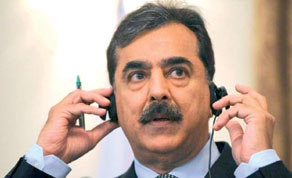
Undre fire: Prime Minister Gilani has pledged to fight on, saying only the speaker is constitutionally empowered to deseat him
That is all Pakistan’s apex court “jailed” Yousaf Raza Gilani for - in a “till-the-rising-of-the-court” avatar.
But given that he is the only unanimously elected prime minister the country has ever produced, and that the conviction was for contempt of court, it doesn’t get any more serious than this.
Save for diehard party loyalists, there is a sense of embarrassment at the spectre of having a convicted prime minister still at the helm, and ever so determined to carry on, regardless of the merits of the case to which one will return in a moment.
To be sure, no head of a government in a functioning democracy is known to have hung on to the job with the stigma of conviction. The almost universal practice is to step down before waging a legal battle.
The chief executive, in this instance, has decided to continue in the hot seat, pending a decision by the speaker of the National Assembly (who owes her office to Gilani’s party).
Last week’s unprecedented development, which has the inherent potential to derail the system, is not easily explained.
A convicted PM holding fort may be a first, but it is certainly not a legal jigsaw puzzle alone - as some would have us believe. Swirling in the maelstrom is an intense political drama.
Consider this. The superior judiciary led by Iftikhar Chaudhry has a grouse against the ruling Pakistan People’s Party government led by President Asif Zardari, who reneged on his promise to restore it following its sacking by military ruler Pervez Musharraf, who feared it would stall his presidential ambition for re-election in the fall of 2007.
The strongman helped himself to a controversial re-election and subsequently, imposed Emergency, a measure he topped by sending home “independent” judges just when they were poised to decide on the legality of his re-election.
Eventually, Musharraf was forced to resign after Zardari shrewdly used support from arch rival Nawaz Sharif, who had his own scores to settle with the dictator, to threaten him with impeachment.
Just before Chaudhry was dismissed by Musharraf a second time in 2007, the top judge had stayed the so-called National Reconciliation Ordinance (NRO) - a decree passed by Musharraf under which more than decade-old corruption cases against Zardari and his two-time prime minister wife Benazir Bhutto were quashed as part of a future power-sharing deal with the strongman.
Zardari is also said to have a personal grudge against Justice Chaudhry, who in the past ignored the former’s pleas for early hearing, when he was in jail over corruption charges after Benazir had been ousted from power during an earlier stint.
In an alleged payback, Zardari let the deposed judiciary cool its heels until a popular revolt led by lawyers and the opposition forced his hand in 2009.
The restored judiciary took little time in hearing petitions in the NRO case and, on December 16, 2009, passed a verdict declaring it null and void.
Significantly, it directed the PPP government to reopen the cases forthwith - including an order to write a letter to the Swiss authorities to proceed against President Zardari.
For more than two years now, the PPP government has defied the orders citing presidential immunity, prompting the apex court to start contempt proceedings against the prime minister earlier this year.
Gilani appeared before the Supreme Court bench thrice, declaring his inability to follow the orders. Elsewhere, he pledged not to “ditch” his president and party, even if that meant going to jail.
Expecting the worst, the PM was said to have readied his belongings to proceed to Adiala Jail - a rendezvous synonymous with PPP’s ‘prisoners of conscience’.
The ruling party had long prepared for the eventuality although its decision to take on the judiciary only got more pronounced early this month when Bilawal Bhutto, President Zardari’s 23-year-old son and party chairman, made a provocative speech that questioned its impartiality and even accused it of playing the establishment’s game to oust it from power.
Aitzaz Ahsan, the prime minister’s counsel, says the court’s verdict has gone beyond the scope of the charges he was indicted for.
Interestingly, there is dispute over even the existence of a contempt of court law since it could not be exercised the last time a Supreme Court bench reached a similar decision in 2007.
The case was against Islamabad’s top cop for assaulting Justice Chaudhry after he resisted being forced into a car on his way to a hearing following the top judge’s suspension by Musharraf!
In the latest contempt case, the bench was under tremendous pressure not to unravel the evolving democratic enterprise, which has seen an elected government survive huge odds to get into the last of its five-year term and the longest serving prime minister.
The weight of public expectations - to bring to book even the mightiest office-holder to account - while at the same time reinforcing its authority as the sole interpreter of the constitution was palpable.
The court’s short order appears to steer clear of rocking the boat at its own risk. This is why it did not sentence Gilani to an actual prison term and left the door ajar for his disqualification by the parliament/poll commission, if at all.
The PM and his party have since dug their heels and refused to accept the opposition’s demands for Gilani to resign. Both Nawaz Sharif’s Pakistan Muslim League and Imran Khan’s Pakistan Tehrik-e-Insaf have threatened to launch a nationwide agitation to force the PM to resign.
An intense debate continues to fill column inches and dominate TV talk shows about the legal status of the PM.
Despite the predictable chasm it has generated - driven mainly by political rather than legal considerations - it is understandable, for, Pakistan has never before experienced a situation of this vexed enormity.
The cobwebs would be removed only once the detailed judgment arrives as to the determinants of the short order.
This has, however, not stopped the PM, whose counsel will go into appeal once the detailed ruling is made, from categorically asserting he will only accept the Speaker’s verdict since “the parliament is supreme to all other pillars of the state”.
l The writer is a freelance journalist based in Islamabad and can be reached at [email protected]