


By Anna Tomforde/London
“Gotcha!” was the memorable tabloid headline that encapsulated British jingoism after the sinking of an Argentinian warship that resulted in the loss of more than 300 men during the Falklands War of 1982.

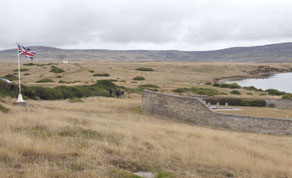
The British military cemetery in San Carlos Village in the Falkland Islands. Thirty years ago a remote South Atlantic island chain was thrust into the global glare as Britain and Argentina went to war over the Falklands, triggering a bitter conflict which rankles to this day
When former Argentinian dictator Leopoldo Galtieri ordered his forces to invade the Falkland Islands on April 2, 1982, he had probably not reckoned with the steely determination of Margaret Thatcher, the then British prime minister.
It took the Iron Lady just three days to send a massive British naval taskforce to the disputed islands - which are located 13,000km from Britain and are known as the Malvinas to Argentina - to engage in a three-month military campaign that left 900 dead.
Forcefully and impatiently brushing aside deep reservations from inside her own cabinet, the military and the US secretary of state, she is portrayed as saying in a recent film starring Meryl Streep: “We cannot appease aggression. Either we stand on principle or we will not stand at all.”
Thatcher, now 86 and suffering from dementia, is expected to take part in the British commemorations of the conflict, which take place on June 14, the day of the Argentine surrender. Galtieri, her one-time adversary, died in 2003.
It is generally accepted by historians and political analysts that victory in the Falklands conflict proved the defining moment of Thatcher’s premiership, enabling Britain to leave behind the grim economic legacy of the 1970s and restoring its postwar status as a major power.
When she came to power in 1979, her government was mired in economic troubles, battling with powerful trade unions and fighting the constant threat of Northern Ireland terrorism.
Even though she was - and still is - a deeply divisive figure, the tabloid-inspired nationalism created by the war is widely seen as having ensured a second term for Thatcher, who ruled until 1990.
Thirty years after the conflict began, sensitivities are still raw on both sides.
“A lot of people did die,” Victor Bulmer-Thomas, a Falklands expert at the London foreign policy think tank Chatham House, said.
But despite the current renewed sabre-rattling over the conflict, he believes there is “no political will or desire” in Argentina for renewed military action. The same is true of Britain, where there is “no appetite” for whipping up the tension, he said.
The British government, which has consistently pledged that it stands ready to defend the sovereignty of the islands as long as Falkland islanders wanted to remain British, should “resist the temptation of overreacting” to recent Argentinian moves to reignite the dispute, he suggested.
Meanwhile, some in the British military have seized upon the Falkland Islands issue to criticise the government for its deep defence cuts, which mean, for instance, that Britain no longer has its own aircraft carrier. The number of frigates and destroyers has also been drastically cut.
Lord West, a former head of the navy who commanded HMS Ardent, which was sunk in the 1982 conflict, said the navy could not retake the Falklands now without major investment.
But the Conservative-led government of Prime Minister David Cameron has consistently played down suggestions of a possible repeat of the 1982 conflict, even though one of its most advanced frigates, HMS Dauntless, has been sent to the South Atlantic.
“There is no current evidence of intent or ability (by Argentina) to launch a credible threat to the Falkland Islands,” Defence Secretary Philip Hammond told parliament.
Nonetheless, the defence of the Falkland Islands remained a “high priority” of the British government, which needs to remain “extremely vigilant” over the issue, added Hammonds.
Foreign Office diplomats, while expressing concern about recent Argentinian attempts to garner support from neighbouring countries for imposing an “economic blockade” on the Falkland Islands, have made clear that they are keen to avoid an escalation of the rhetoric.
They maintain that a “diplomatic offensive” to improve relations with key Latin American states is bearing fruit, and imply that verbal support for Argentina’s pinpricks over the Falklands would not extend to concrete action that would jeopardise those countries’ economic and trading interests.
But, while Britain is prepared to talk to Argentina about key issues such as fisheries, sea and air links and hydrocarbon exploration and management, it would “never compromise on its defence of the islanders rights to determine their own future.” - DPA