


By Michael Stephens/Doha
The case of Mohamed Merah, the 24-year-old Frenchman responsible for three separate attacks in Toulouse leading to the death of seven people, has raised serious questions about the relationship between politics, faith and socio-economic integration not only in France, but across Europe.

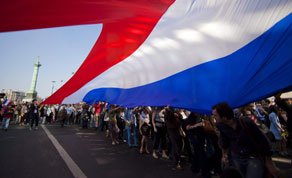
People holding a giant French flag during a march organised by human rights groups in Paris in an effort to show unity between different religious communities following the shootings in Toulouse by Mohamed Merah
The evidence points to a man prone to misdemeanour and troublemaking, but desperately in search of structure and a guiding force in his life.
Merah sought unsuccessfully to join both the French Army and the Foreign Legion, traditional bastions of “Frenchness” in addition to his suspected training in Afghanistan for Al Qaeda. In Merah’s case one sees a man fundamentally searching for a cause. That it was not always to the mosque or the radical factions of Islam points to the bizarre paradox in which this man lived.
There is little confusion as to the triggers behind Merah’s intent to kill; indeed he freely expressed his unhappiness with Israel’s oppression of the Palestinians and French military actions that led to the death of Muslims in Islamic countries. Furthermore it appears he was unhappy about aspects of French domestic politics surrounding issues of Halal food and the right of women to wear the Niqab (face covering).
But the clean-shaven, Western-clothed, club-going, alcohol-drinking Merah hardly fits the cliche of the devout Jihadi. He was, to all intents and purposes, a Frenchman through and through, whose background happened to be Muslim, and not a Muslim who happened to be French. This begs the question as to how Merah’s ideology became so skewed away from his French roots.
Here it is instructive to look at socio-economic conditions prevalent in France for certain communities. It is no secret that French citizens of North African descent have not been as socio-economically mobile as other minorities. Rates of disorderly behaviour are disproportionately high, no better expressed than in the severe urban disturbances that occurred in October 2005 in which French youths mostly of North African descent living in HLM (subsidised low income) housing rioted for two weeks leading to the arrest of 2,900 people.
It is not the case that all Frenchmen of North African heritage have been alienated in this way, indeed two of Merah’s victims were themselves men of North African origin proudly serving in the military. But it is clear that at the macro level France is struggling to deal with a specific sector of the population whose depressed socio-economic position has been a driver in the rise of Islamic identity amongst men of North African origin.
In scholarship on the topic of extremism one often hears of the phrase “Jihadi cool” to describe the attraction of young men of the Muslim faith living in Europe to violent extremism. The underlying rationale for the title being that it is seen as cool to be associated with an ideology whose basic core is to fight back against oppression and the tyranny of Western governments.
The attraction of a young man, alienated by lack of finances and racism, to such an ideology comes from the basis of his need to push back against a domestic apparatus of state which he perceives oppresses him. In short it is an Islamically-wrapped expression of the traditional anarchist cry “down with the system!”
Merah need not be a pious Muslim to have understood the attraction of such a message. For a man in and out of trouble with the police, and unable to get a job in the apparatuses of the French state, the attraction to radicalism is quite clear. It offered purpose and identity for a man who lacked both.
Indeed there seems to have been little opposition to Merah’s views from within his immediate circle. His brother Abdelkader Merah said he was “proud” of Mohamed, and may have been an accomplice to his killing by aiding Mohamed in the stealing of the scooter used to escape the crime scenes.
This climate of permissiveness for Merah’s actions is important in understanding how he was allowed to drift toward an ideology which made the killing of innocent people acceptable. In the last two years of his life, there appears to have been little counter-narrative to his political ideas or to his continued engagement in petty crime.
A seemingly perfect storm of personal disappointments, perceived cultural alienation combined with easy excuses of French military operations in Afghanistan, all played a part in creating a remorseless killer. Mohamed Merah was no Jihadist but a man vulnerable to seeking quick fix solutions to complex crises of personal identity.
All of this makes Mohamed Merah a more dangerous individual than the turbaned clerics of Tora Bora. A young man flirting with dangerous ideologies in search of a purpose is difficult to understand, his descent into violence impossible to predict. Although he was known to French security services, they clearly did not see the warning signs, nor indeed could they.
Is Merah a lone wolf? Most likely; but the more important point is that he was the product of a larger social malaise which has allowed young men to lapse into a new form of violence, a “pick-and-choose” form of extremism in which many aspects of Islam are totally disregarded. It is altogether much harder to spot and identify than the Bin Ladens of old, and requires a reformulation of the way in which we view violent extremism. One in which traditional prejudices against Muslims are pushed aside, and personal and community factors are given precedence.
** Michael Stephens is a Researcher at the Royal United Services Institute (RUSI) based in Doha. Follow him on Twitter @MStephensGulf