


By Kamran Rehmat/Islamabad
The debate over who killed Benazir Bhutto, a two-time prime minister, is a matter of detail that pales before the colossal loss Pakistan continues to endure, four years on.

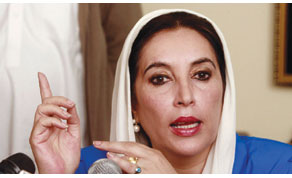
The dearly departed: Four years after Benazir’s assassination, Pakistan continues to endure the colossal loss of a distinguished leader
A nation with a troubled history like Pakistan is wont to endure mishaps and calamities but the assassination of the larger-than-life Benazir is in a league of its own.
From becoming the first Muslim woman prime minister and entering the Guinness Book of World Records as the only chief executive to give birth whilst in office to her tragic assassination — when widely tipped to win an unprecedented third term — everything about Benazir was unique.
The Benazir saga is enigmatic and, at once, more fascinating than any screen epic. Zulfikar Ali Bhutto, her father and Pakistan’s first popularly elected prime minister, initiated the rites of passage for Benazir.
He once said of her: Benazir will be more popular than Indira Gandhi — and even more successful. The inspirations were purposely nurtured when Bhutto took along Benazir to the Simla Summit in 1974 to have her meet the Indian ‘Iron Lady’ in person.
Little would Bhutto have known that his Oxford, Harvard-educated daughter would meet as tragic a fate as one that continues to haunt Pakistan, more than three decades after his execution at the behest of a despot, who overthrew his elected government.
Ms Bhutto herself saw abortive terms in power — thrown out each time on charges of corruption: once by a military-controlled president, who had no love lost for her, and the second time by her own hand-picked president!
The Benazir persona remained a subject of intense media scrutiny all her life. The outside world, in particular, was intrigued by how and what made her a force to reckon with, especially when the chips were down.
The most prominent feature of her endurance is the myth associated with her, which as explained by its Greek origin, does not necessarily belong to the realm of true or false and hence, has no particular meaning.
The myth means as many things to as many of its followers. And therein lay its power. The more the number of meanings, the stronger is the grip of the myth.
The myth of the Bhutto family, or to use its more contemporary form, the myth of Benazir Bhutto had scores of meanings: a woman whose father faced the gallows and was hanged; whose brothers were killed in highly controversial circumstances; whose husband remained incarcerated more than half their marital life; whose ailing mother was hopelessly torn apart in the daughter-son duel for power; who twice stood by the coffin (in her father’s case, she wasn’t even allowed burial) and thrice grieved; the scheming politician, who didn’t shy away from cutting deals (one of which paved the way for Musharraf’s eventual ouster).
Her relationship with Islamabad, whether in or out of power, was unique in many ways. In fact, one could safely assume that the capital city and its garrison twin, Rawalpindi, saw her fiery best — particularly, as an opposition leader who could tear the script with sterling defiance.
The invocation was rooted in the anti-establishment stance that has since diluted as part of a studied endeavour by Asif Zardari, her widower and current president, to retain power but never lost its symbolic value for liberal forces.
The chutzpah was unparalleled in the time Benazir led the country’s largest political party, with the only aberration being her period in exile when she pulled her party’s strings with little impact — until a series of blunders by the Musharraf regime turned the tide.
The Long March calls, the spectacular stunts — she once reached the Liaquat Bagh for a public meeting on a motorbike, giving the police, law enforcement and secret agencies’ personnel the slip with the finesse of a trained mission impossible daredevil — and those unnerving ‘Go Baba Go’ chants in the face of the establishment — then-president Ghulam Ishaq Khan — contributed to perhaps, the most fascinating period in the political history of the twin cities.
It was a time when despite the ominous but familiar hand that rocks the democratic cradle in this South Asian nation and the divisive nature of politicking, the twin cities were alive and kicking with not a dull moment to spare.
I met her twice, once when her government had been dismissed a second time in 1996 and soon after over lunch at the Islamabad Club.
One did not always concur with some of her policies but that indefatigable struggle for democracy overrode much of the paradox that lay in an autocratic mien.
She had this magical ability to hold her own. The best demonstration of this one saw at a news conference following the second dismissal of her government by estranged comrade, then-president Farooq Leghari. She had emerged nearly 48 hours after his ‘backstabbing’ — with husband Zardari’s whereabouts still unknown.
But tiding over both personal and political misfortune, Benazir stole the show with her defiance in the Prime Minister House before a battery of national and international media persons with a command performance as if she was a stage artiste.
It was a unique instance in Islamabad’s otherwise unforgiving history of treating deposed premiers — even if it was only down to a bumbling Leghari still struggling to establish his authority.
Nothing however, compares to how the politically astute Benazir manoeuvred to get back into power in 1993, winning the military establishment’s favour and deftly using her first tormentor-in-chief Ghulam Ishaq Khan to her advantage once former rival Nawaz Sharif had fallen out with him even though her party boasted only a dozen-and-a-half seats in the National Assembly.
In classic payback, she then sent an unsuspecting Khan into oblivion by declining to name him as a presidential candidate.
Politics aside, a whole generation grew up accustomed to seeing Benazir around regardless of affiliation or detachment. When winter clasps leafy Islamabad, even afternoons can send a chill down one’s spine. So arresting was Benazir’s presence that it appears a resonant part of the nation died along with her.
**** The writer is a freelance journalist based in Islamabad and can be reached at [email protected]