


By Scott Malone/Boston
From Capitol Hill and Wall Street to small towns across the US, discussions of the economy have focused on one key question for the past two years: When will corporate America start hiring again?

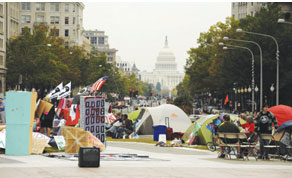
Occupy DC protesters camped out in Freedom Plaza in Washington, DC. The group is calling for an end to wars and for jobs
That may be the wrong question. With Europe’s debt crisis rattling the world financial system and demand fading, the question on many executives’ and economists’ minds is whether the nation is on the brink of another large round of layoffs.
It does not help that the uncertainty that has sent the Standard & Poor’s 500 index down more than 10% since mid-July is lingering into October when big companies start planning out their 2012 budgets. At the very least, executives said it looks unlikely that companies will start the significant rounds of hiring that would be needed to drive down the nation’s unemployment rate, currently 9.1%.
“I think people are in the process of dialling back 2012 expectations and that will bleed into whatever they were planning,” said Michael Neal, a General Electric Co vice-chairman who heads the company’s GE Capital finance arm. “My view is they continue to stay with a tight belt and I think it means less hiring than they would have done otherwise.”
Weak earnings reports from JPMorgan Chase & Co and Alcoa Inc are only increasing the market’s anxiety, and the tone of executives’ comments are far from upbeat.
Chief executives have already begun to echo the warning that US President Franklin Delano Roosevelt made early in the Great Depression of the 1930s: “The only thing we have to fear is fear itself.”
“I’m more concerned about lack of confidence than about market fundamentals,” Alcoa CEO Klaus Kleinfeld said on Tuesday. “It almost looks like the world is worrying itself into another recession and that should not be allowed to happen.”
Their concern about worry has not stopped them from acting, though. JPMorgan yesterday said it would cut 1,000 jobs from its investment banking business.
JPMorgan’s cuts follow a much larger move by Bank of America Corp, which last month said it would eliminate some 30,000 jobs - about 10% of its workforce. While smaller in scale, earlier this month drugmaker AstraZeneca Plc, Level 3 Communications Inc and Verso Paper Corp all disclosed plans to cut hundreds of jobs.
Some 24% of large-company chief executives expect to cut jobs in the US over the next six months, according to a survey by the Business Roundtable. That is more than double the 11% who expected to cut in the June edition of the survey, but less than the 36% that planned to add jobs.
Theirs is a darker view than that of the chief financial officers of mid-sized companies, where 68% expect to add jobs over the next year, down from 80% earlier this year, according to a GE Capital-sponsored survey.
Companies are also cutting their spending plans for the US. Wal-Mart Stores Inc, the world’s largest retailer said on Wednesday it plans to cut its US capital spending by 7.4% next year.
“If the economy continues to slow ... I expect companies probably to continue to keep payroll very lean and for the unemployment rate to bump to 9.25%, conceivably it could go to 9.5%,” said Michael Yoshikami, CEO of YCMNET Advisors, a San Francisco investment house with $1bn under management. “As CFOs and (human resources) managers are planning going forward, you can’t avoid the human dynamic here. And if the outlook is very uncertain, they’re going to be very, very hesitant to make broad hiring decisions. It’s not good timing because budgets are being set right now.”
One warning sign that more belt-tightening could be ahead is that profit growth seems to be slowing down. Most US public companies report quarterly results in the coming weeks, and earnings season has gotten off to a weak start.
Analysts have lowered their growth forecasts for the companies of the S&P 500 and now look for overall profit for the group to rise 12.5% in the third quarter, less than the 17% they expected at the start of July.
The sharpest downward revisions have come in the finance sector, where analysts now look for profit to rise just 1.7%, down from a prior expectation of 15.6%. They’ve also lowered estimates for companies that sell basic materials like metals, telecommunications firms and sellers of consumer staples like food.
The finance, retail and manufacturing sectors could all see cuts - with retailers particularly vulnerable if the holiday selling season is weak, analysts said.
“We certainly are on a cusp here and it does feel as though the economy has downshifted,” said John Challenger, CEO of Challenger, Gray and Christmas, a consulting company that helps laid-off executives find jobs. “A lot of companies are coming into this last quarter cautious and they’re not optimistic ... It feels like the economy could turn either way.”
One hopeful sign for workers is that companies that cut head count aggressively during the recession may have little fat left to trim, making them more likely to hold off unless the economy definitively weakens.
“There might be some firms that decide to preemptively cut, but I think that many firms are pretty lean and mean,” said Michael Goodman, director of economic and public policy research at the University of Massachusetts at Dartmouth. “Even though output has been growing, that’s with tens of millions of fewer workers on the job. So it’s tough to imagine too much more work being squeezed out of fewer employees in this environment.” – Reuters