


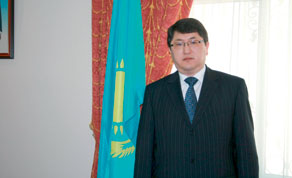
By Azamat Berdibay/Doha
 |
|
Ambassador Berdibay: “Qatar is an important partner of Kazakhstan in the region” |
Sixteen years ago, on August 30, 1995, a new Constitution of Kazakhstan was adopted after a nationwide referendum, replacing the country’s Basic Law of 1993, which was originally defined as a transitional constitution.
The new fundamental law of the country has absorbed the best international experience of constitutional development of states on various stages of development.
The main political document’s adoption has become a turning point in our country’s history.
The Basic Law laid the foundation for the positive processes of development and strengthening of government institutions and society, providing necessary conditions for dynamic development of economic, social and cultural potential of Kazakhstan.
The Constitution established a high standard for democratic reforms in state and society.
At the same time, the fundamental law of Kazakhstan was not out of social development: its updating happened periodically. In 1998, several articles of the Constitution were amended. For example, the institution of elections under party lists was established. The process of shifting the centre of gravity from the president to parliament has been started.
The basis for subsequent implementation of the consideration of criminal cases by jury has been laid. This has been successfully used in Kazakhstan in recent years. In accordance with the amendments, introduced to the Basic law in 2007, Kazakhstan became a unitary state with a presidential-parliamentary form of government.
As was noted by the President of the Republic of Kazakhstan, Nursultan Nazarbayev, “the Constitution approved the solidarity of the people, united on the Kazakhstan land the citizens of all ethnic groups, linked by the common historical destiny. Born by the single nation-wide will, it became a creative basis for the development of the country”.
This year is a jubilee one for the Republic of Kazakhstan. Almost 20 years ago, on December 16, 1991, Kazakhstan declared its independence by adopting a law on state sovereignty.
Today, after the passage of two decades, we can confidently say that Kazakhstan has become a successful sovereign state and an equal partner in the global community.
After gaining its independence, Kazakhstan has faced the whole complex of problems that require immediate solutions. All of them have been resolved.
Within a short period of time Kazakhstan has completed the process of delimitation of borders with all neighbouring countries.
The economy is developing with an accelerated pace and the citizens’ well-being growing. New industrial facilities are being implemented, new jobs are created. During the years of independence, Kazakhstan’s GDP increased 12 times and now is over $9,000 per capita.
During these years the country attracted more than $120bn in foreign investments, which is about 80% of funds raised in the economies of whole Central Asia.
The country has also successfully coped with the effects of the global financial crisis.
Year by year, spending on education and health has been steadily increasing. Over the past 10 years it has grown more than eight times. A unified network of intellectual schools is created throughout the country. A new Nazarbayev university has been opened in Astana.
The government effectively combats corruption. According to the latest report of “Transparency International”, Kazakhstan rose by 15 places in the “Corruption Perceptions Index”, having moved from 120th place out of 180 countries last year to 105th place among 178 countries in 2011. In general, within two years, Kazakhstan has risen by 40 places in this ranking - a tremendous achievement by any standards.
Kazakhstan today has not only proven itself as a successful state but has also become an influential regional power, making a worthy contribution to the global security and co-operation.
All this is the brilliant result of extraordinary activity of President Nursultan Nazarbayev - the architect and builder of the new Kazakhstan, convincing evidence of his recognition as a truly global leader, who provides strategically right path of development.
As a responsible partner in the global policy, Kazakhstan is making all efforts to counter new challenges and threats while offering its vision of the solution of urgent regional issues.
In 1992, President Nazarbayev put forward the idea of the Conference on Interaction and Confidence-Building Measures in Asia (CICA), which brings together 22 states, which occupy 90% of Asia and half the population of the planet, and is a dynamic forum for security and cooperation.
Convincing evidence of increasing authority of Kazakhstan in the international arena is the successful and effective OSCE chairmanship in 2010 and, in particular, conducting of the OSCE summit in Astana, first in 11 years, which, according to international experts, gave a new impetus to this authoritative international organisation.
International leadership of Kazakhstan is continuing by this year’s presidency in the Shanghai Co-operation Organisation, as well as the chairmanship in the Organisation of Islamic Co-operation. It is also a recognition of the impressive successes of Kazakhstan in socio-economic and political development since its independence.
It should be mentioned that the co-operation within the framework of OIC can fully contribute to the strengthening and development of collective security systems, both regionally and globally.
Kazakhstan considers the interaction with OIC as one of the priorities of its foreign policy, as the organisation makes a significant contribution to maintaining peace, stability and security, as well as trade, economic, cultural and humanitarian co-operation in the world.
The Customs Union of Belarus, Kazakhstan and Russia has begun its work. By some estimates, its creation will help stimulate economic development and can provide an additional 15% of the GDP of participating countries by 2015.
The Republic of Kazakhstan is a reliable partner, the initiator and conductor of global solutions on ensuring security and dialogue of civilisations.
August 29 was declared by UN the International Day of Actions against nuclear testing. On this day in 1991 President of Kazakhstan has closed nuclear testing ground in Semipalatinsk.
For the people of Kazakhstan experienced all the horrors of nuclear testing, the question of their total ban is particularly significant. During 40 years, 450 tests, which affected half a million people, were carried out at the Semipalatinsk test site.
Kazakhstan gave up the fourth largest nuclear arsenal in the world and forever closed the nuclear test site. During his visit to Kazakhstan and Semipalatinsk nuclear test site in April 2010, UN Secretary-General Ban Ki-moon urged the leaders of all countries, especially the nuclear powers, to follow the example of Kazakhstan in the field of disarmament and nonproliferation.
Speaking about the relations between Kazakhstan and Qatar, I would like to notice that Kazakhstan and Qatar have long-standing traditional relations of peace and friendship.
Qatar is an important partner of Kazakhstan in the region. A high level of interaction in all spheres of bilateral co-operation have been reached in the relations between our two countries under the guidance of our leaders, President Nursultan Nazarbayev and HH the Emir Sheikh Hamad bin Khalifa al-Thani.
In conclusion I would like to take this opportunity to congratulate all Muslims on the occasion of the Eid al-Fitr, the Holiday of happiness and joy, and wish to all good health and family welfare, prosperity to our countries, peace and harmony to our people.
***Azamat Berdibay is ambassador extraordinary and plenipotentiary of Kazakhstan to the State of Qatar