


By Kamran Rehmat/Islamabad
The first generation of contemporary media reforms in Pakistan brought about an increase in media space. This has seen TV channels going up from one to nearly a 100 and radio stations from one to about 150.

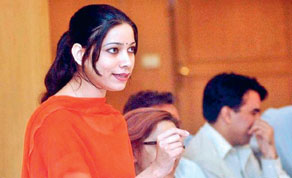
Rising to the occasion: a participant raises a question during a media workshop in Islamabad to address gender issues
It has also led to an increase in the number of media practitioners — from 2,000 journalists in 2002 to over 17,000 now — and a surge in media pluralism (multi-national, multi-linguist, multi-ethnic media).
The second generation reforms are now setting in with the emphasis of media evolution shifting from quantity to quality. Hence the general realisation that carving out niches (as opposed to cloning oneself after the next media organisation) and developing thematic expertise is growing within the media sector. And thank heavens for it because if this won’t happen then the general slide into tabloidisation will continue.
One of the keys to this transition is, of course, thematic expertise. The more a beat system is strengthened, the more likely it is that reporters become better oriented with different subjects. It follows that the better reporters understand a subject the better they will be able to report on them.
It is with this view that designing proper trainings on thematic issues for media is key to ensuring that they don’t leave a training without substantially having become wiser about the thematic issue in question.
Take the International Labour Organisation (ILO), a UN organisation working, among other things, in Pakistan to improve the work environment for women in particular as a stepping stone to their empowerment and a more equitable world for them.
They have recently launched a project to this effect called Gender Equality for Decent Employment (GE4DE). A big part of this includes building capacity of Pakistani media in gender sensitive reporting and raising awareness about issues related to gender equality.
They aim to educate about 800 journalists in the theme and therefore better portrayal of working away in media.
To this effect ILO’s Pakistan office conducted a consultation with 44 media analysts, expert trainers, gender specialists and development sector professionals on what would be a good training module.
The respondents were asked different questions regarding training for journalists which would aim to improve their skills for gender sensitive report, with special emphasis on reporting on working women. They were asked to identify key themes that reporters could focus on to improve portrayal of working women in Pakistani media.
There were plenty of interesting answers. One of the reoccurring themes was the role of society in defining gender roles with variations of the theme including understanding how gender is socially constructed, understanding cultural sensitivities towards gender, role of civil society in promoting gender sensitive reporting, old concepts of male domination, getting around cultural constraints of reporting on gender sensitive issues, changing mindsets and bringing behavioural change in the society and looking at how the role of women has evolved in the Pakistani society.
Respondents have suggested reporting on key trends in women’s economic choices and productivity, impact of women business leaders, trends in women’s participation in national labour force, invisible women from workplace, budgets, economic indicators like gender gaps in employment and earnings and a critical analysis of equal opportunity in work place including hiring, promotion, perks, trainings and salary.
The legal situation regarding women was also a theme chosen by many of the respondents. Suggestions have been made to report on legal parameters, laws regarding women, political recognition of equality of women and the link between fair gender practices and good governance, democracy and social development.
Respondents also noted a dire need for promoting gender sensitive reporting where the reporters do not just understand the sensitivities linked to the issue but are also capable of penning down stories without using stereotypical or sexist terminology, realise the need to be sensitive when editing pictorial content and realize the role of media when it comes to promoting perceptions about women in general and working women in particular.
Respondents have noted that journalists should be trained to engage rape victims and girl child with sensitivity. They should realise the difference between fact and opinion and should be able to report with accuracy, and without bias sensationalism.
The need for a code of ethics when reporting on women has also been emphasised.
Media needs to portray women as active and effective members of the society as well as project the healthy and essential bond between both genders.
Only a society where both males and females complement each other in their respective fields of activity can develop on a sustainable basis.
For instance, presenting a father who is concerned for the education, health and overall wellbeing of his children is as necessary as presenting a mother with all her care for them.
Materialistic and capitalistic view of life admits only that person to be successful who excels in terms of wealth and power. Human traits like sacrifice, truthfulness and honesty do not define his status in the society.
This mindset impacts family system that is essentially based on sharing and caring instead of snatching from them whatever can be acquired. There is now a greater emphasis that the media needs to protect and promote human values through its depiction of role models. Such portrayal should not only avoid negative portrayal of women but also refrain from gender bias.
A number of respondents have also stressed the need to ensure gender equality in media and have suggested looking into how media reconstructs gender roles.
Other suggestions include training female reporters to talk to men, training male reporters to talk to women, lobbying through respective platforms, promoting individual rights of women, identifying gender stereotypes and reporting on women’s role in community responsibilities. Another recurring theme is quality reporting about the various issues that women are especially vulnerable to, including health care and the prison system.
A need to promote the positives regarding women has also been highlighted. The respondents have suggested that reporters focus on the resilience of women, replace the word “survivors” for “victims” and try to highlight as many positive stories as possible.
*** The writer is a freelance journalist based in Islamabad and can be reached at [email protected]