By David E Miller/The Media Line
The Arab Spring was supposed to bring democracy, peace and prosperity. But stalemates between governments and opposition forces are paralysing economic life, exacerbating food shortages that were already in the making due to unfavourable weather and rising world prices.

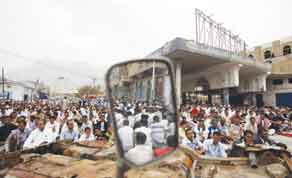
Anti-government protesters are reflected in the mirror of a motorcycle as they attend the weekly Friday prayers during a rally to demand the ouster of President Ali Abdullah Saleh in the Yemeni city of Taiz. A United Nation mission visiting Yemen has called on the international community to quickly provide humanitarian aid to the impoverished country which has been pushed to the verge of starvation by five months of protests and armed insurrection
Reports of widespread hunger have emerged in recent weeks in Libya and Syria. On Wednesday, Yemen was officially added to the list of food trouble spots when a United Nation mission visiting Yemen called on the international community to quickly provide humanitarian aid to the impoverished country, pushed to the verge of starvation by five months of protests and armed insurrection.
“Before the unrest began, 7mn Yemenis were forced to reduce their number of daily meals from three to one,” Aziz Al-Athwari, Yemen country director at Oxfam, a British aid agency, told The Media Line.
“Although we have no current statistics, that number has certainly increased since fighting began.”
Seven million is equal to nearly a third of Yemen’s population.
The UN’s World Food Programme (WFP) recently launched an emergency operation to feed 1.7mn severely food insecure Yemenis. The poorest country in the Middle East, Yemen has been rocked by deadly protests since late January demanding President Ali Abdullah Saleh’s ouster.
All three Middle East countries suffered from food and water shortfalls even before unrest broke out, preventing inputs like seeds and fertiliser reaching farmers and severing transport links to markets.
But with fighting in Libya and Yemen nearing reaching their fifth month and unrest in Syria nearing its fourth, economic paralysis has become the norm.
And as the fighting goes on, world food prices are rising. In June they reached a near record led by sharp increase in sugar prices outweighed a slump in the grains complex, the UN’s Food and Agriculture Organisation (FAO) said the other day.
The FAO’s food price index, which covers prices of a basket of commodities, rose 1% to 234 points last month, up 39% compared with the same time last year and just below the record 238 points hit in February.
Food prices are likely to stay at historically-high - and volatile - levels well into 2012, the FAO said.
Al-Athwari traces the growing hunger in Yemen to mounting fuel and diesel costs. Not only food but water is delivered to many communities by truck, and rising transport prices have lifted the price of food and water beyond the ability of the average Yemeni to pay.
As a result, he says, Yemenis have reduced their water consumption, causing public health and sanitation conditions to deteriorate.
“Fifteen-hundred liters of water used to cost $5, but now cost $20,” Al-Athwari adds. “Many day labourers have lost their jobs and can no longer afford this.”
In Libya, the fighting between government and opposition forces has severely harmed the supply of food and medication, particularly to the Western Mountain Region which is entirely dependant on outside supplies, says Reem Nada, a Cairo-based public information officer for the World Food Programme.
Libya is almost entirely dependent on food imports but the country’s ports have been shuttered for months.
“The World Food Programme is concerned with the collapse of the public distribution system, affected by the situation in Libya,” Nada told The Media Line.
“Due to heavy fighting in Libya’s Western Mountain Region, markets are closed and there is a lack of cash and fuel. Some areas have no electricity or water.”
Her organisation has distributed 6,000 tons of food to Libya since March and has designated 22,000 additional tons for Libyans and refugees who have fled to neighbouring Tunisia and Egypt.
According to the UN Refugee Agency (UNHCR), more than 1mn refugees have so far fled Libya as a result of the fighting.
Syrians too have suffered hunger due to a drought that has plagued the country’s northeast since 2006, described by the WFP as “the worst in decades”. Mass migration from Syria’s rural agricultural areas into cities has ensued.
Some 1mn Iraqi refugees living in Syria are the most vulnerable to food shortage, as they are not allowed to work or own land to sustain themselves.
For Syrians struggling with less food in the markets, the problem was made worse by cuts in food subsidies and frozen wages after 2004. In the weeks before unrest broke out in mid-March, the Assad government restored some of those subsidies and raised salaries for civil servants. But with the economy paralysed, it’s not clear the government can afford to increase aid or distribute it. The fighting, however, has been a major cause of hunger in Syria.
In mid-June, government forces loyal to President Bashar al-Assad blocked food from reaching Syrian villages near the border with Turkey, where thousands of internally displaced refugees had gathered fleeing government violence.
“This is a starvation war they’re waging,” Jameel Saib, a local eyewitness, told CNN, adding that refugees were forced to pluck fruit from trees in order to survive.
Ali al-Saffar, a Middle East researcher at the Economist Intelligence Unit, a London-based researcher affiliated with The Economist magazine, said food scarcity and high inflation were one of the root causes of Arab uprisings.
“Rising prices of food and fuel played out to disenchantment,” al-Saffar told The Media Line. He added, however, that the acute food shortage was not a structural problem in the Middle East but rather the result of military conflict, meaning the situation is reversible. “No one is expecting this food insecurity to go on forever,” he said. 2011.