


By Ben Blanchard/Beijing
China’s expected launch soon of its first aircraft carrier will add to a growing military clout just as other powers in Asia are becoming uneasy about Beijing’s more strident claims over disputed seas in the region.

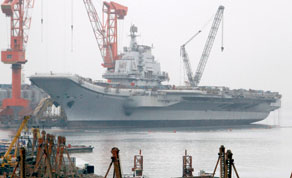
China’s first aircraft carrier Varyag, which is expected to be launched this week
In practical terms, though, it is likely to take the Chinese navy years to have a credible carrier operation in Asia’s seas, which have largely been the domain of the US navy since World War Two.
The former Soviet carrier, one destined to become a floating casino, is part of President Hu Jintao’s push to modernise the navy and could be presented to the world as soon as this week to coincide with the 90th anniversary of the founding of the Communist Party on July 1.
China is already busy upgrading its destroyers and submarines to sail further and strike harder, building a “blue water” navy to project power far from its shores and to protect the sea lanes on which its trade-reliant economy depends.
An aircraft carrier fits neatly into that strategy. It could end up being based in the southern island province of Hainan, which sits strategically atop the disputed and potentially energy-rich South China Sea.
“It will be the clearest possible signal that China intends to operate at sea in a sustained fashion,” said Dean Cheng, a China security expert at the Washington-based Heritage Foundation.
“Given the ongoing tensions in the South China Sea, it is an unmistakable signal to Manila, Kuala Lumpur, Jakarta, as well as Hanoi and any other regional capitals that the Chinese are serious when they describe their maritime territories as ‘blue soil,’” he added.
“Indeed, given the rising tensions, this is something that can be expected to ratchet up tensions.”
Other powers in Asia are already alarmed at China’s growing military prowess - defence spending is growing fast and in January it confirmed it had held its first test flight of the J-20 stealth fighter jet.
In recent weeks, China has been flexing its muscles more aggressively in the South China Sea, where a territorial dispute with Taiwan and several Southeast Asian nations, including Vietnam and the Philippines, has festered for years.
Australian policy think tank the Lowy Institute warned on Tuesday that risks are growing incidents at sea involving China could lead to war in Asia, drawing in the US and other powers.
Earlier this month, Chen Bingde, chief of the People’s Liberation Army’s general staff, confirmed via Hong Kong media that the country was indeed building a carrier.
The 300-m (1,000-ft) Varyag is undergoing refit at a state-run shipyard in northeastern city Dalian, sources have told Reuters. Images of the rust-stained ex-Soviet ship have appeared on Chinese websites, apparently being re-fitted.
A Chinese firm bought the then-engineless Varyag from Ukraine in 1998 for $20mn, planning to convert it into a floating casino in Macau, but it then ended up in the hands of China’s military.
China says it needs to upgrade its outmoded forces and that its plans are not a threat to any country, pointing out that its defence budget is far lower than the US.
Beijing in March said it would boost defence spending by 12.7% in 2011, for a total of 601.1bn yuan ($92bn), marking a return to double-digit growth.
The cost of building a medium-sized conventionally powered, 60,000-tonne carrier similar to the Russian Kuznetsov class is likely to be more than $2bn. China is likely to acquire at least two, sources say.
But China, which would be the third Asian country to have a carrier after India and Thailand, needs hardware, software and pilot training in order for the ship to present a credible deterrence.
Chinese pilots have yet to master takeoffs and landings from carriers, and it is far from certain what aircraft would use it as a base.
While they have been undergoing training, they have far fewer flying hours than their US peers and are in any case considered by analysts to be far more poorly trained overall.
“It could take up to five more years before you could say that thing is operationally deployed and then they have to learn how to do carrier battle group operations,” said Richard Bitzinger, a senior fellow and regional defence expert at Singapore’s S. Rajaratnam School of International Studies.
“The bottom line is, it’s going to take them a long time before they can say they have a fully operational carrier, and it’s going to take them a lot longer before they can actually say that PLA is a carrier-based navy.”
For Beijing, the rationale of an aircraft carrier is more than just about modernising a navy whose most notable engagements of the past few years have been skirmishes in the South China Sea with some of the other claimant nations.
China’s sending of naval vessels further afield, to the waters off Somalia to fight pirates, and through the southern Japanese islands, has also partly been about ensuring trade routes are protected.
“We are a major trading nation and need to have the ability to ensure the security of the sea lanes,” said Xu Guangyu, a retired major general in the People’s Liberation Army who now works for the government-run China Arms Control and Disarmament Association.
“(The carrier) is hardly going to be used to attack Tokyo, New Delhi or Hanoi”, he added.
To complain about the country’s naval air ambitions smacked of hypocrisy, Xu said.
“The US has 11 aircraft carriers and nobody makes a fuss about them ... But it will take time for other countries to become used to the idea of China having an aircraft carrier.” — Reuters