


By Ric Parker/London
As the aerospace industry gathers in Paris today for the yearly air show, many participants will have fuel efficiency in light of rising oil prices high on their agendas. High oil prices are driving aircraft operators to look for improvements in specific fuel consumption (SFC), whilst growing worldwide demand for aviation by both consumers and businesses is likely to see the sector’s carbon dioxide (CO2) emissions increase in both absolute and relative terms.

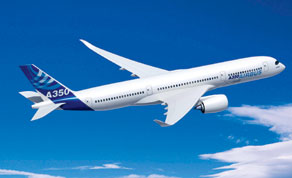
When the first Airbus A350 is delivered to Qatar Airways in 2013 it will be powered by Rolls-Royce’s Trent XWB engine
And for those who live on the flight path, engine noise can be a significant issue. At Rolls-Royce we are applying technology, on an industrial scale, to respond to these challenges.
But to succeed, the whole industry must work together, pooling its innovation and applied research in both products and processes. Increasingly fuel-efficient engines must play a big part but so too must advances in airframe technology and improved air traffic management and operations. Never has collaborative teamwork been so vital.
An example of that collaboration is the Boeing 787, which has as much as 50% of the primary structure - including the fuselage and wing - made of composite materials. The aircraft is powered by the Rolls-Royce Trent 1000 engine which will, at entry into service, with ANA later this year, be the cleanest, quietest lightest and most efficient engine for the aircraft.
The engine has over 18,000 components which power an aircraft weighing over 553,000lbs up to 8,000 nautical miles. It operates in temperatures between -60OC and +40OC. At its heart the engine reaches a temperature nearly half that found on the surface of the sun and the pressure is the same as that half a kilometre down in the ocean. On each journey it uses the same amount of fuel per passenger as a modern car whilst travelling 10 times faster.
If, overnight, we could replace a previous generation of planes, for example the 767, with the 787 we could save over $1.5bn in fuel costs and 5mn tonnes of CO2 every year.
For engine designers the most efficient engine design is a question of balance. Higher overall pressure-ratio cycles improve fuel burn, thereby reducing CO2, but the propensity to create NOx increases. Similarly improvements in noise brought about by increasing the bypass ratio of turbofan engines, may add weight and drag of the increasingly low-pressure systems resulting in higher overall fuel burn, and hence increased CO2.
When the first Airbus A350 is delivered to Qatar Airways in 2013 it will be powered by the company’s Trent XWB. The XWB is the most fuel-efficient engine available. The state-of-the-art compressor and turbine aerodynamics as well as a low-emissions combustor, blisk (bladed disc) technology in the compressor, the latest high strength materials and high temperature coating technology and a lightweight titanium fan for additional weight savings all contribute to improving fuel efficiency and reducing emissions.
At takeoff the fans on each of the Airbus A350’s two Trent XWB engines spin at over 2,700 rpm with tip speeds of over 900mph (faster than the speed of sound) moving over a tonne of air per second and producing 85% of the engine’s thrust. The force on a fan blade at take off is equivalent to a load of almost 1,000 tonnes the same as a freight train hanging off each blade.
Such performance only comes about as a result of successful investment in research and development to create, patent and protect new technologies. A considerable financial investment is also involved. Rolls-Royce spent £923mn last year, and has allocated over £4.2bn in the last five years to research and development.
The company works with the world’s best academic researchers at institutions with proven track records to produce groundbreaking technology. An example of such collaboration is the hollow titanium fan blade which is crucial to the efficiency of our large aero engines. It took the expertise of seven universities over 10 years to develop.
Innovation is essential right through the value chain – from technology concept to product hardware – investments are also being made in a global network of Advanced Manufacturing Research Centres. These bring together universities, equipment suppliers and manufacturing technology providers, plus production companies and their supply chains to develop world-leading manufacturing systems and processes that can be applied to mutual benefit across entire supply chains.
Innovation is also an area that the Middle East is looking to expand on by the private sector collaborating with governments to train engineers of the future.
It is clear that developing more efficient large civil aero engines with reduced environmental impact requires technically sophisticated solutions applied on an industrial scale. That, in turn, requires the scale of resources and sustained commitment to innovation that only companies which have the technology, the systems integration skills and the long-term commitment to sustained investment in research and development can provide.
**** Ric Parker is Rolls-Royce’s director of research and technology.