


By Oliver Burkeman/London
 |
|
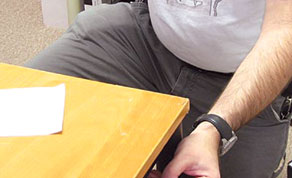
The Annoy-a-tron: this small device, when armed and hidden, generates very short and very annoying beep every couple of minutes. With its thin design and embedded magnet for easy hiding, the Annoy-a-tron can be placed in a variety of locations |
The Annoy-a-tron features in Annoying, a fascinating book just published in the US, in which the science journalists Joe Palca and Flora Lichtman attempt to penetrate the essence of what irritates us. (They fall short of an overarching theory, which is annoying, but perhaps that’s only appropriate.)
Annoyance turns out to be remarkably neglected by psychologists, who try to define it away as a version of anger or frustration; there are, Palca and Lichtman note, “No department(s) of Annoying Studies or annoyingologists.” But there are recurring traits, at least for aural irritations, and the Annoy-a-tron illustrates one: the agonising hope that the annoyance might have ceased. It’s the same with car alarms, or people clipping fingernails on public transport: the silence between bursts is almost more excruciating than the bursts themselves.
This hints at something fundamental about annoyance: the violation of expectations. Our brains can’t help but seek consistency or predictable patterns. Silence would be fine, and a regular beeping would be tolerable – but not knowing whether the beeping’s stopped is unbearable.
Studies have demonstrated that “halfalogues” – mobile phone conversations where you can hear only one speaker – are more distracting than monologues or dialogues: we involuntarily struggle to make sense of the exchange, but can’t. People with perfect pitch get driven wild by office appliances that hum just flat or sharp of musical notes.
Even the things that annoy us about romantic partners fit this mould. If you married a slob, you might be depressed, but not annoyed. It’s the unslobbish partner who leaves coffee grounds in the sink who’s truly irritating.
Much of this may be culture-specific: according to some anthropologists, the Ifaluk of Micronesia live an almost irritation-free life, perhaps because inhabiting a small atoll makes frictionless collaboration crucial.
Other forms of irritation may be universal, even evolutionarily adaptive: fingernails on a chalkboard, one psychologist tells Palca and Lichtman, resemble the cries some monkeys make when predators approach. (He recreated the sound in experiments by scraping a “three-pronged garden tool” over slate. Just reading that makes me want to kill him.) For less acute annoyances, if the violation of expectations is key, it follows that the irksomely obvious remedy is to try to relax your expectations, to demand less consistency from your surroundings. Go with the flow. And the car alarms. And the fingernail clipping. And that beeping that keeps – wait, I think it’s stopped now... — Guardian News and Media