


By Annie Sweeney/Chicago
 |
|
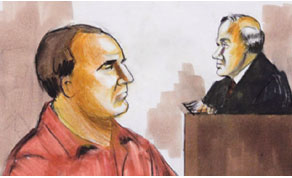
Flashback to 2009: a courtroom drawing from December 2009 depicting David Headley |
Tahawwur Hussain Rana, who is married and raised three children, is alleged to have provided a cover for the scout who checked out locations for the deadly rampage and acted as a messenger for the terrorist group behind the attack.
The case was already expected to be the most important terrorism trial ever in Chicago, but it has taken on even more significance since the killing of Al Qaeda leader Osama bin Laden brought renewed attention to Pakistan’s commitment to fighting terrorism as a key ally of the US Testimony is expected to reveal a troubling link between at least one of Rana’s co-defendants and Pakistan’s largest intelligence agency.
The trial will pit childhood friends against each other. The government’s star witness, David Coleman Headley, who met Rana when the two attended a Pakistani military school in their youth, pleaded guilty to scouting targets for the Mumbai assault and agreed to co-operate with authorities to avoid the death penalty.
Prosecutors have also charged six others with ties to Lashkar-e-Taiba, the Pakistani group. All of them are fugitives, leaving Rana the lone defendant to go trial in federal court for the bloody attack on India’s largest city in which about 170 died, including six US citizens, and hundreds others were wounded.
“It’s obviously important,” James Kreindler, a New York attorney who represents Mumbai victims in a pending civil lawsuit against Pakistan, said of the criminal trial set to begin on May 16 with jury selection. “Any person who loses a family member to an act of mass murder wants to see the guilty convicted and punished. From our point of view, this should only be the beginning.”
Federal authorities also charged Rana and Headley in a plot - never carried out - to bomb a newspaper office in Copenhagen. According to the charges, the plot followed calls by Al Qaeda for attacks on Danish interests to avenge the publication of unflattering cartoons about the Prophet Muhammad that had inflamed much of the Muslim world.
An influential leader of the Islamic Struggle Movement, another militant group, is also charged in connection with the plot. He was in regular contact with Al Qaeda, the indictment alleged.
The relationship between Rana - who denies all involvement - and Headley will be a central issue in the trial that will feature secretly recorded calls and e-mails, some allegedly penned in code, in addition to critical testimony from Headley about the plots.
While the government has cast Rana as key to Headley’s efforts to scout targets in both Mumbai and Denmark, his attorneys have argued that their client was duped into helping an old friend.
Indeed, Rana, who has been married 21 years and is described by his attorneys as an entrepreneur, has no criminal background. In court, he displays a calm and engaged manner, greeting attorneys with a nod and smiling at the occasional light remark during the otherwise serious proceedings.
In contrast, Headley, the son of a Pakistani diplomat and American socialite, has had a troubled and controversial past. He was convicted decades ago of smuggling heroin from Pakistan and then turned informant for the US Drug Enforcement Administration. By 2002, he trained at Lashkar camps in Pakistan, authorities have charged.
In the meantime, Rana, a former military doctor in Pakistan, had started several businesses in the Chicago area, including one on the busy Pakistani-and-Indian strip of Devon Avenue.
Prosecutors allege that more than two years before the Mumbai attack, Headley enlisted Rana’s assistance after Headley had been assigned by Lashkar contacts to conduct surveillance for potential targets in India. Headley had changed his name from Daood Gilani so as not to draw attention in his travels overseas.
Rana is charged with letting Headley use his business - First World Immigration Services Inc. on Devon Avenue - as cover when Headley travelLed to India to scout for sites to attack. Headley made five separate trips, taking photographs and videos to help a team of gunmen who would carry out assaults on hotels, a Jewish centre and other locations.
Rana also is accused of passing e-mails between Headley and a Lashkar commander who was added to the indictment last month.
Ten assailants - all young - came ashore in Mumbai in November 2008 and went on a rampage that lasted three days.
A month or two later, Headley allegedly advised Rana of the plot to attack the Copenhagen newspaper, according to the charges. Again, he obtained Rana’s approval to pose as a representative of First World and supplied him with business cards, authorities charged.
During the planning, Headley gave Rana a copy of the video in which Al Qaeda called for attacks in retaliation for publishing the Prophet Muhammad cartoons, the indictment alleged.
By late summer 2009, Rana agreed with Headley that funds that had been provided to Rana could be used to finance the plot to attack the newspaper, Jyllands-Posten, prosecutors charged.
Headley scouted the newspaper office in Copenhagen, but the plot never materialised.
FBI agents in Chicago arrested Headley in October 2009 while he was trying to board a flight at O’Hare International Airport. He pleaded guilty in 2010 to all dozen counts against him, including conspiring to murder and maim people in India and plan bombings there. Headley also admitted to plotting the bombing of the Denmark newspaper.
Headley agreed to testify against Rana in exchange for avoiding the death penalty as well as extradition to face charges abroad.
His testimony is likely to go beyond Rana’s involvement and into the highly charged allegation that Pakistani intelligence officials were involved in the Mumbai plot. That could add strain to already delicate relations between the US and Pakistan, experts said.
“Right now is one of the lowest points in the US-Pakistani relationship,” Daniel Markey, a senior fellow at the Council on Foreign Relations in Washington, said even before US forces discovered bin Laden last weekend living in a walled compound not far from Pakistan’s capital.
Markey, who focuses on US policy in Pakistan and India, called the Rana trial “poorly timed”.
“It’s another layering on of serious problems that have emerged,” he said. - Chicago Tribune/MCT