


By Kamran Rehmat/Islamabad
 |
|
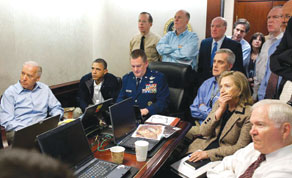
Making history: President Obama with his core security team watching the action in Abbottabad that eliminated Osama bin Laden live in the Situation Room at the White House |
Given the rather secretive nature of not just the operation itself but also ties that bind the American and Pakistani intelligence agencies, it is going to take an equally sensational effort to get the truth out on this one.
For now, what we see is not necessarily what we get. What we know for sure are only statements to go by, which according to CIA Chief Leon Panetta and counterterrorism chief John Brennan clearly say the mission impossible was carried out solely by the US Navy SEALS and special forces to the exclusion of the Pakistanis.
Accounts have, in fact, suggested the Americans jammed all radar communications at Pakistan’s end before successfully completing their mission. That would obviously reflect a strong trust deficit with Pakistanis.
President Asif Zardari also went along with the same view: that it was an American enterprise about which his country had no knowledge.
“Although the events of Sunday were not a joint operation, a decade of co-operation and partnership between the United States and Pakistan led up to the elimination of Osama bin Laden as a continuing threat to the civilised world. And we in Pakistan take some satisfaction that our early assistance in identifying an Al Qaeda courier ultimately led to this day,” the president wrote in a hurriedly-written Washington Post Op-ed piece a day after the Al Qaeda chief was taken out.
Zardari admitted that while the world’s most wanted man “was not anywhere we had anticipated he would be”, Pakistan “did its part”. leading one reader to suggest sarcastically, that it was done by “staying away and doing nothing”.
The Foreign Office in Islamabad also issued a detailed response on Tuesday, denying that Pakistan had advance knowledge of the operation and even took issue with how the U.S. forces had entered its airspace and undertaken the mission without authorisation.
As well as taking the Pakistani civilian leadership by surprise, what the abode and killing of Osama bin Laden has done is to bring into sharp focus the role of the powerful Pakistan’s security establishment.
Open-ended questions have been asked of how and what was the intelligence - premiere of which is the Inter-Services Intelligence (ISI) - up to while the world’s most wanted fugitive lived right under the nose of Pakistani Military Academy Kakul in Abbottabad, the equivalent of British Sandhurst.
With ISI - feared and admired in equal measure across the world - it is of course, never an easy explanation. The BBC found an unnamed official from the agency expressing embarrassment about the episode.
Saying that the ISI had raided the place in 2003 but that the compound where Osama was holed up was not on their radar lately, he was quoted as saying: “We’re good, but not God”.
A gem of a quote to look good on a TV screen or in fine print perhaps, but not necessarily with any meat or bones given the hideout where Osama was lodged - for months, if not five years as is being suggested by the US - killed and taken away without so much as a whiff.
Even as ordinary Pakistanis and the world at large are at the proverbial sixes and sevens as to how neither the Pakistani security establishment appeared to know about the Al Qaeda chief’s Abbottabad lodging nor was onboard with regards the operation to get Osama, it is imperative to keep in mind that not all information trotted out in public holds true for obvious reasons.
According to reliable information but which cannot and has not been made officially available, not only was the top Pakistani military leadership fully onboard about the assault on the Al Qaeda chief but reportedly, even facilitated it. This was evident even circumstantially, with swathes of the area removed from the compound cordoned off and power disconnected close to the attack time.
The fact is that while acknowledging Islamabad’s co-operation, both President Obama and Secretary of State Hillary Clinton affirmed in carefully, chosen words the role of Pakistan in leading the US hunt to the compound.
Residents in the vicinity of the compound housing Bin Laden also spoke of how they were shooed away by Pakistani security personnel away - apparently, in plain clothes -from the scene when many of them ran out scared from their houses on hearing the noise of the helicopters.
This leaves us with the question of why the mission remained an exclusively American enterprise, especially against the past practice of a joint operation where Pakistan often played the dominant role in nailing high value Al Qaeda targets before handing them over.
Notwithstanding the CIA chief’s attention-diverting assertion in a Time magazine interview that they feared Pakistan might alert Osama, insiders suggest Islamabad shied away from taking any role, leave alone a frontal one, because it feared a severe backlash from the extremists were they to finish off the Al Qaeda chief.
The other view, still unconfirmed at this point of time, is that the Obama Administration coveted exclusivity to the “ultimate trophy” whose symbolic significance cannot be overstated given how costly - $470bn - has been Washington’s endeavour to demolish the terror network unleashed by the man who it finally brought to justice.
Late Tuesday, White House Press Secretary Jay Carney made some of the more compelling comments about Pakistan’s very effective role in netting the top Al Qaeda leadership generally as well as combating terrorism and paying a huge price for it.
However, this does not detract from how Osama was able to reside in Abbottabad as long as he did without being noticed. In the days and weeks ahead, Pakistan will find the kitchen heat rising and few avenues to get out.
Even if the US and Pakistan have colluded in bringing Osama to justice, the US will find in his enigmatic Abbottabad hideout an opportunity to push Islamabad to do more as it has done since 9/11.
*** The writer is a freelance journalist based in Islamabad.