


By Kamran Rehmat/Isalamabad
 |
|
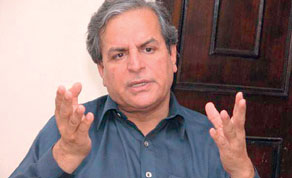
Making a statement: Javed Hashmi is winning hearts and minds across Pakistan |
Not only did the heartfelt notes from the once-firebrand and now much mellowed leader of former prime minister Nawaz Sharif’s Pakistan Muslim League make it to the front pages of mainstream national dailies but also invited editorial comment signaling newfound respect for a politician, who has dared to be different.
In 2004 while taking a connecting flight from Lahore to Islamabad on a Pakistan International flight, there was a buzz on the plane as it prepared to take off. Just then I spotted Hashmi in the distance.
Predictably, passengers started to walk up to him and congratulate him, assuming that he had finally been freed by the military regime of General Pervez Musharraf.
I asked Masood Khan, the Foreign Office spokesman at the time, sitting nearby if the government had indeed decided to call time on his incarceration.
But he was as clueless as I was only for us to see Hashmi shaking his head and informing the curious lot that he was merely being taken for a court hearing in the garrison city of Rawalpindi.
Hashmi was referring to what he maintains to this day was a politically motivated case of inciting mutiny by Musharraf’s regime.
He was arrested from the parliament on October 29, 2003 nine days after he read out a letter that he received in mail, signed anonymously by some active military officers at the army’s General Headquarters, calling for an investigation into the corruption in the armed forces and criticising Army Chief General Pervez Musharraf.
Significantly, the trial was held in the Rawalpindi’s Adiala Jail instead of a district and sessions court at the Lahore High Court, raising doubts about its fairness.
On April 12, 2004, Hashmi was sentenced to 23 years in prison for inciting mutiny in the army, forgery, and defamation.
The verdict did not surprise many given how Hashmi openly defied the dictator - going to the extent of calling for an independent investigation into the Kargil war and an end into the military’s meddling into politics.
He was declared a political prisoner even by arch rival Pakistan People’s Party (PPP) of former prime minister Benazir Bhutto. During incarceration, he wrote a famous autobiography, somewhat aptly entitled Haan Mein Baghi Hoon (Yes, I’m a Rebel).
A Supreme Court bench led by Iftikhar Mohamed Chaudhry, who had only recently been reinstated following his forced exit by Musharraf early in 2007, granted Hashmi bail after three-and-a-half years in prison while the military ruler was still around.
Fast forward to last week. As well as apologising to the nation for having once accepted a ministerial position under dictator General Zia-ul Haq decades ago, which he described as his life’s greatest regret, Hashmi stunned all comers by asking his leadership to follow suit for seeking Musharraf’s mercy and choosing a decade’s exile over fighting it out back home.
Sharif was pardoned after a court had convicted him in the infamous plane hijacking case where he was charged with trying to stop the army chief from landing on his return from a visit to Colombo. The two had fallen out over the Kargil episode. Musharraf then ousted Sharif in a coup.
Hashmi, who led Sharif’s party in his absence with some gumption, but was sidelined upon the latter’s return from exile in 2007, also asked every other politician, who had worked for or under an authoritarian regime to find the courage to seek the nation’s forgiveness as well as pledge never to breach their trust again.
Sharif chose to appoint Chaudhry Nisar as the leader of the opposition when all logic pointed to the indefatigable Hashmi as the more appealing choice thanks to the wide respect he enjoyed across the political spectrum.
However, Sharif appeared to be clearly wary of his own aide’s popularity even as he appeared to use that to his party’s advantage. For instance, he asked Hashmi to fight old nemesis Sheikh Rashid in Rawalpindi, where he had never lost an election.
Rashid had deserted Sharif whilst he was in exile and there was no love lost between the two.
Hashmi defeated Rashid comprehensively as well as winning two more seats to create a record for a Pakistani MP — three of the four seats he was asked to contest.
In the same parliamentary speech, observers did not fail to notice how Nisar had a red face listening to Hashmi and went out of the House to probably, alert Shahbaz Sharif, chief minister of Pakistan’s most populous province Punjab and the younger brother of Nawaz on what one of their most seasoned colleagues had to say.
Hashmi also spoke of his pain at seeing his one-time object of ire, Benazir Bhutto, being assassinated. He recalled that he had cried, a rare occurrence in his adult life, at the loss and said he considered both her father Zulfikar Ali Bhutto and herself as martyrs.
Bhutto Senior was hanged 32 years ago over disputed charges of abetment to the murder of a political opponent, by a judiciary which is widely perceived to have been adjudicating at the behest of the military ruler General Zia-ul Haq, who had ousted the country’s first popularly elected prime minister from power.
Hashmi, who suffered brain haemorrhage in July last year and had to be hospitalised with speech impediments, rose to also make an impassioned appeal to his party leadership to consider the creation of more provinces in Punjab, in particular in the southern region, which the PML-N is loathe to do for fears it would cut into its vote bank.
It is the same demand that is being floated by the ruling PPP and other PML-N detractors, too, on the premise of giving autonomy but which, the Sharifs allege, is just a ruse for dividing the party’s vote bank.
Proposing still more provinces, Hashmi’s take was that Sharifs would do well to remember that if (such an idea) suited Pakistan it was better to eschew party interests.
Over the weekend, he flew unannounced to a mass protest organised by Pakistan Tehrik-i-Insaf chairman and cricket legend Imran Khan in Peshawar against the US drone strikes in what was seen as another manifestation of Hashmi’s growing national stature.
Khan is a bitter critic of both Hashmi’s PML-N and the PPP.
For a nation attuned to seeing the bad side of politics and politicos, small wonder Hashmi has become a major draw.
** The writer can be reached at [email protected]